
This the first installment in a new series we’re calling Art Across Senses, taking a deeper dive into the experience of accessibility in OKC’s arts institutions and exhibitions, and into the minds and insights of the organizers, administrators, and curators behind the scenes that make that accessibility possible for visitors of all kinds:
OKLAHOMA CITY – Accessibility in public attractions and community spaces is often most effective not by just marking checkboxes, but through intentional choices and design.
But accessible design is about more than just physical aides and mobility accommodations, especially in the worlds of arts, culture, and entertainment, where considerations must also be made for things like vision, hearing, language, and social engagement.
One local institution that’s worked hard to address those needs for visitors is the Oklahoma City Museum of Art (OKCMOA).
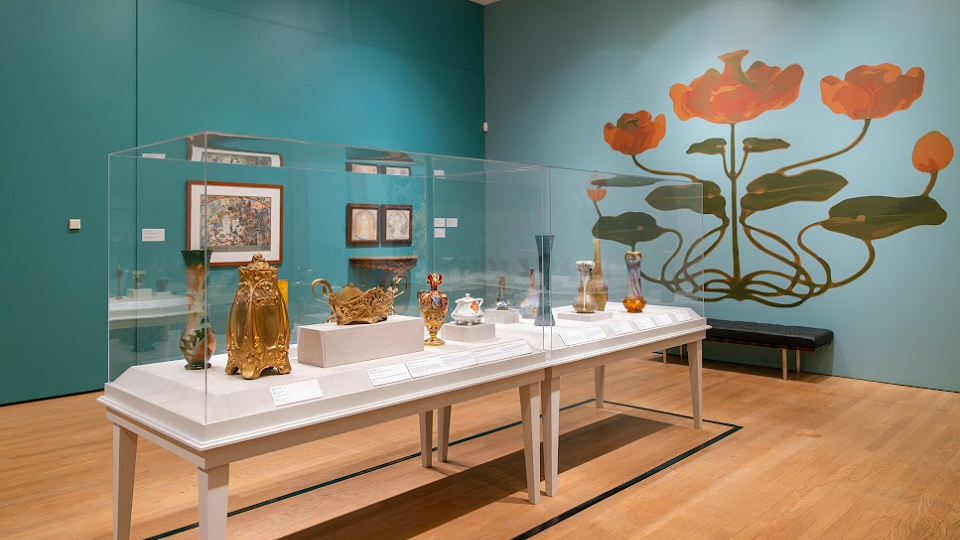
Free Press reached out to learn more about how they design visitor experiences for wider audiences, including in their presentation of the national traveling exhibition “The Triumph of Nature: Art Nouveau from the Chrysler Museum of Art,” which is on view now.
Art & accessibility at OKCMOA
OKCMOA offers diverse accessibility services, ranging from mobility and sensory needs, to accommodations for individuals with hearing or vision loss. The museum also recognizes that visitors with disabilities may not feel comfortable visiting alone and offers free admission for one companion, such as a sighted guide or caregiver.
For visitors with limited mobility, free, accessible parking is available on Couch Drive for up to two hours. Inside OKCMOA, attendees can speak with a Visitor Services staff member about access to manual wheelchairs and rolling walkers, which are also available for free. The museum’s entrances and public spaces, as well as its restrooms, are wheelchair accessible.
For visitors who are Deaf or hard-of-hearing, if given three weeks’ advance notice, OKCMOA can provide ASL interpretation for museum programs and gallery tours. They also have two hearing-assist headsets that provide amplified audio within the Noble Theater.

OKCMOA provides a range of social narratives, also known as social stories. For individuals with language or developmental challenges, or people on the autism spectrum where social differences are part of the diagnosis, these short, clear narratives are designed to better understand what to expect during an art museum visit.
OKCMOA currently offers stories on visiting the museum, museum manners, visiting the museum with a class, and helpful staff members.
For visitors with sensory considerations, accommodations extend to quiet spaces for individuals and families needing breaks, along with sensory kits.
“We are currently partnering with KultureCity, a nonprofit organization that provides sensory inclusive training for staff members,” said Bryon Chambers, OKCMOA’s Co-Interim Director and Director of Education & Visitor Experience. “Through this partnership we have been able to make modifications including signage and access to ‘Sensory Inclusive Bags’ that offer tools and resources for guests with sensory needs, such as noise-cancelling headphones, fidgets, weighted lap pads, and communication tools.”
Visual art for individuals with vision loss
OKCMOA shared that, in addition to visitors with sensory needs, they’re actively serving visitors with blindness or low vision.
When designing for accessibility in arts institutions, the question inevitably arises: how can a visual art museum be accessible to visitors with vision loss? While often understood as a visual experience, there are many ways to engage with a work of art.
It’s key to understand that vision loss occurs on a spectrum and doesn’t always refer to total blindness. While some individuals experience total blindness, others have partial vision loss that ranges in intensity and location. For example, a person may have lost their central sight but can still see through their peripheral vision, while another person may have numerous dark spots in front of their eyes that make the world appear as if looking through a piece of patchy lace.
OKCMOA meets diverse vision needs so visitors who are blind or visually impaired still have opportunities to experience visual culture in an art museum setting. Visitors with partial vision loss may benefit from requesting large print labels, available at each gallery entrance.
The museum also provides access to sighted guides, provided requests are made with three weeks’ notice. Sighted guides, also known as human guides, involve a navigation method where a human partner safely leads a person who is blind or visually impaired, especially through an unfamiliar environment. Service dogs are also welcome.
Companions supporting someone who is blind or visually impaired can provide image description, the process of translating the visuals of an artwork into clear, detailed words.
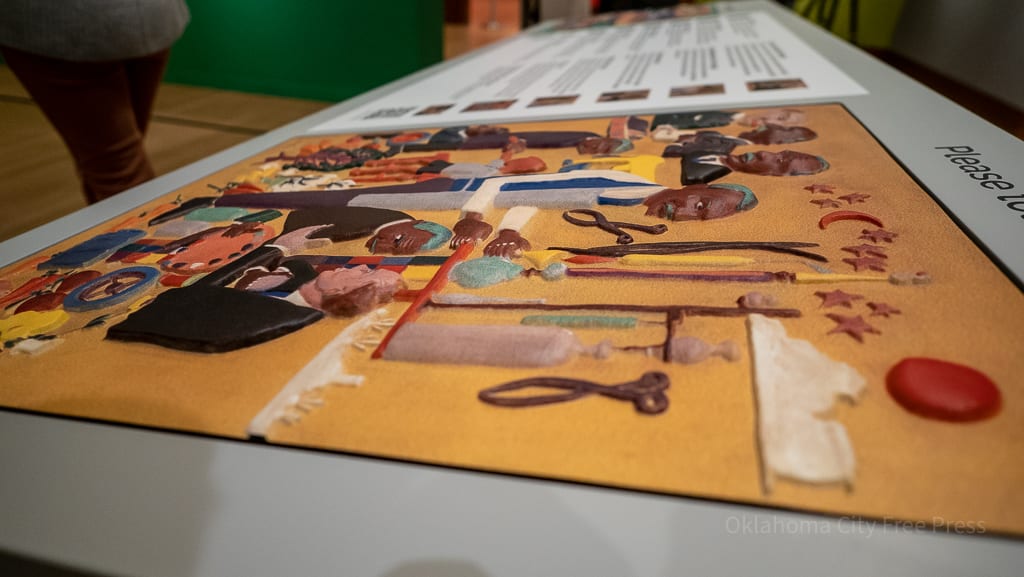
On OKCMOA’s second floor, tactile relief versions of art gives visitors the opportunity to ‘see’ works through their sense of touch, mapping form and texture with their fingertips.
For OKCMOA visitors among the more than 10 million Americans who experience color blindness, the museum can loan EnChroma glasses, designed to improve the range and saturation of color vision for people with red-green color blindness.
Accessibility in OKCMOA’s ‘The Triumph of Nature’
These accessibility offerings also apply to “The Triumph of Nature,” which features artworks that epitomize key art historical movements from the late 19th and early 20th centuries, including organic Art Nouveau, Japonisme, inspired by Japanese aesthetics, and geometric Art Deco.
“We strive to make the Museum a welcoming space for all,” said Chambers. “Like all of our exhibitions, ‘The Triumph of Nature’features bilingual text, QR codes that visitors can scan in order to access visual descriptions and label audio for select objects, as well as white cane guides throughout the galleries. With advance notice, additional accessibility accommodations, including ASL interpretation, can be made for any tours of the exhibition.”
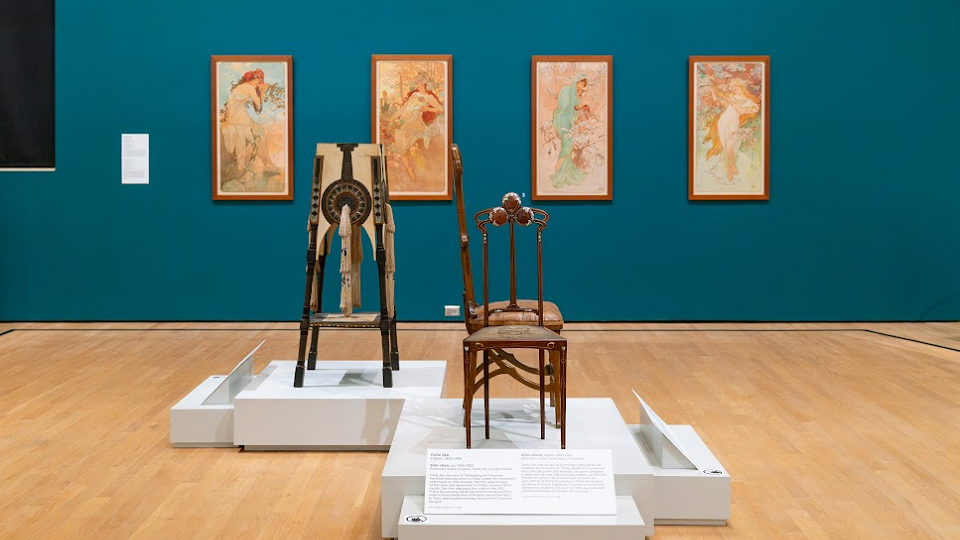
OKC Free Press also spoke with “The Triumph of Nature” curator Lloyd DeWitt to learn more about an artwork that holds particular significance for him as a curator.
“The Orivit ‘Mermaid’ candlestick says it all,” said DeWitt. “Feminine beauty, experimentation with materials, [including] the lead-tin alloy, in imitation of silver, [which] developed severe problems over time since it was experimental, combining metal and crystal, the exuberant creativity, the indulgent eroticism and escapism of Art Nouveau are all here in this one piece.”
DeWitt’s explanation provides key insights into the candlestick, also referred to as the Orivit “Mermaid Candelabra,” including its media, craftsmanship, and how it brings the exhibition’s themes into clearer focus, highlighting the ways that visual description can offer a rich experience of art for those that rely on descriptive text.
For some visitors to “The Triumph of Nature,” those words can serve as a bridge, helping form a detailed mental picture of the artwork. That’s why OKCMOA has partnered with Bloomberg Philanthropies to utilize their Bloomberg Connects app, providing audio tours and visual description text for the museum galleries and many of the pieces within.
Guests using the app will find detailed visual descriptions like this one for “The Triumph of Nature” standout “Eighteen-Light Pond Lily Lamp” from the Tiffany Glass and Decorating Company:
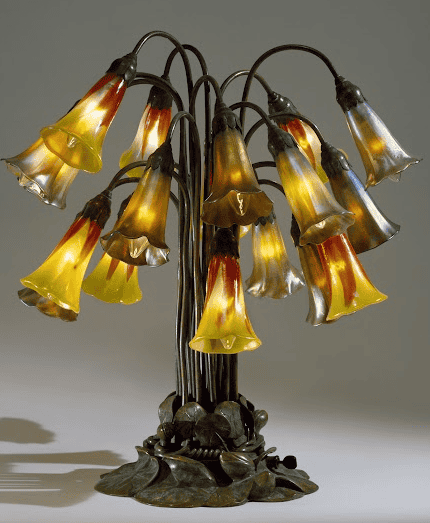
“This is a lamp, measuring a little over one and a half feet tall and one and a half feet wide.
The lamp has eighteen iridescent glass shades in the shape of blossoming flowers. They range in color from dark golden yellow to lemon yellow, with strips of brick red extending from their base.
The circular base of the lamp is composed of overlapping dadrk olive-green metal lily pads and lily buds.
The lamp’s body is formed by a column of metal lily stems that gradually curve outwardr at varying heights, branching out into the individual glass shades.”
Find a full list of services on OKCMOA’s accessibility page.
For more information on the arts and accessibility in OKC, see Here’s your guide to accessibility in OKC’s arts institutions.

Erin Schalk serves as a professional writer, visual artist, voice narrator, and accessibility-centered educator. She is the recent recipient of multiple Writer’s Digest awards and the Armed Services Arts Partnership’s National Scholarship. She has also received a Best of the Net nomination. Schalk’s work has appeared in Wordgathering, Stirring Lit, Parentheses International Literary Journal, The Petigru Review, and numerous other publications. She also received her MFA from the School of the Art Institute of Chicago.