

UPDATE: 8/3 – The City Council has deferred the Flock Safety contract renewal from the August 4th meeting agenda.
A City of OKC representative said the decision was made “so City staff can make changes to the agreement,” but could not comment on what those changes are expected to be at this time.
There is currently no word on when the contract renewal vote will now take place, even as the City’s existing contract with Flock expired at the end of June.
Free Press will report when the item is added to a future City Council agenda and will cover the meeting and vote closely.
The original article has been preserved below:
OKLAHOMA CITY – The Oklahoma City Council is expected to vote Tuesday on whether to renew and continue OKC Police’s contract with controversial Flock Safety following new revelations about their cameras’ usage, increasingly vocal pushback, and even some national attention for how they’ve been implemented in OKC.
This would be the third annual renewal of an available four for the existing contract in OKC, which gives both police and Flock employees unprecedented access and archiving capacity for troves of identifying data collected through the company’s Automated License Plate Reader cameras, or ALPRs.
In recent months, dozens of cities across the country have canceled or rejected similar contracts with Flock over privacy concerns and questions of surveillance overreach that have led to cities cutting ties with the company in states as varied as Texas, Oregon, Florida, Colorado, Tennessee, and more than twenty others.
A growing chorus of voices in Oklahoma City is now demanding the same, even as police officials and some City leaders say the camera system is vital for crime-solving and insurance enforcement, beliefs that have been challenged by national members of the ACLU that visited OKC in May.
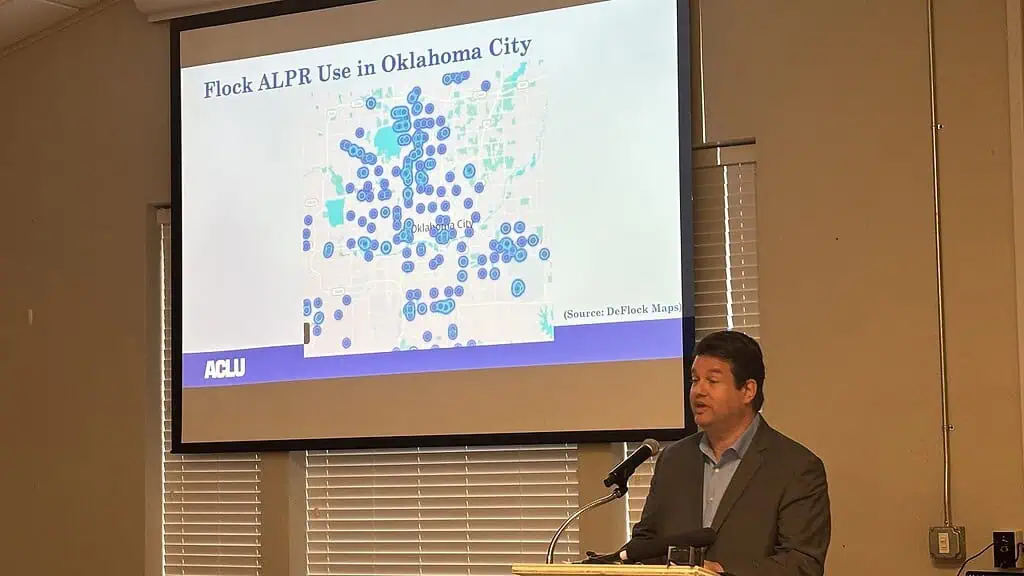
“Oklahoma City appears to be all in on Flock, and that is quite troubling,” ACLU’s national-level senior policy counsel Chad Marlow said, addressing a packed crowd inside Mayflower Congregational for a community town hall meeting to discuss Flock cameras. “I feel comfortable saying that Flock is the most problematic ALPR company in the country.”
But proponents of the Flock system argue that the capabilities of a high-tech camera network and an easily searchable, AI-powered database of footage creates a system uniquely suited to crime-solving needs in a large city.
”I know some people are a little questionable on it,” said Ward 4 City Councilman Todd Stone during the July 2025 meeting where the contract was last renewed, “but if you’ve ever had your vehicle stolen and that somehow helped you get your vehicle back, you’d really appreciate it.”
What are the concerns about Flock cameras in OKC?
The issues highlighted by Marlowe, the ACLU, and a widespread collection of other activists and civil rights advocates stem both from general privacy and surveillance concerns about all ALPRs and from lingering questions of oversight and access specifically for the cameras operating in Oklahoma City.
In March, IT professional Jarrett Freeman published a large selection of documents obtained through open records and FOIA requests that show a near-total lack of regulated oversight regarding how OKC’s Flock cameras – and the nationwide AI-powered data network that drives them – are accessed and by whom, as Free Press reported at the time:
Those documents included an internal memo compiled by the OKCPD and sent to the City of OKC Municipal Counselor’s Office in response to Freeman’s questions that confirmed the department has no reporting, logging, or tracking of who accesses the cameras or the AI network or why.
“There is no transparency reporting or internal usage reporting in our policies, SOPs, directives, training or guidance materials,” the memo reads. “We have not published transparency/internal use reports.”
What issues and accusations have other cities seen?
Those confirmations seem to make clear that the police or Flock employees can access the camera system and AI-cataloged data archive of footage any time without logging or reporting the use. Anti-Flock activists say that opens the door for potential use far outside the bounds of the single stated use for ALPRs in Oklahoma, enforcement of the state’s Compulsory Insurance Law.
In other states, multiple police departments have been accused of accessing Flock camera systems to stalk women, track suspects without a warrant, and compile information on suspected immigrants to be handed over to federal agents.
One Flock employee in Georgia was even shown to be secretly accessing a camera in a gym for young girls during equipment demonstrations to police.
Under Flock’s current contract with Oklahoma City, any use like those could not be reported as a specific user or tracked to a specific time or computer.
How is the City Council expected to vote?
Those concerns have led some City Council members to vow a vote against any contract renewal or continued use of Flock cameras at all, while others have considered the possibility of instead fighting for better oversight, logging, and protections in the city’s Flock system upon renewal.
“My preference is the maximalist position here,” Ward 2 Councilman James Cooper told Free Press in May, joining Ward 6 Councilwoman JoBeth Hamon in starting firmly that they will vote against any attempt to continue Flock operations in OKC.
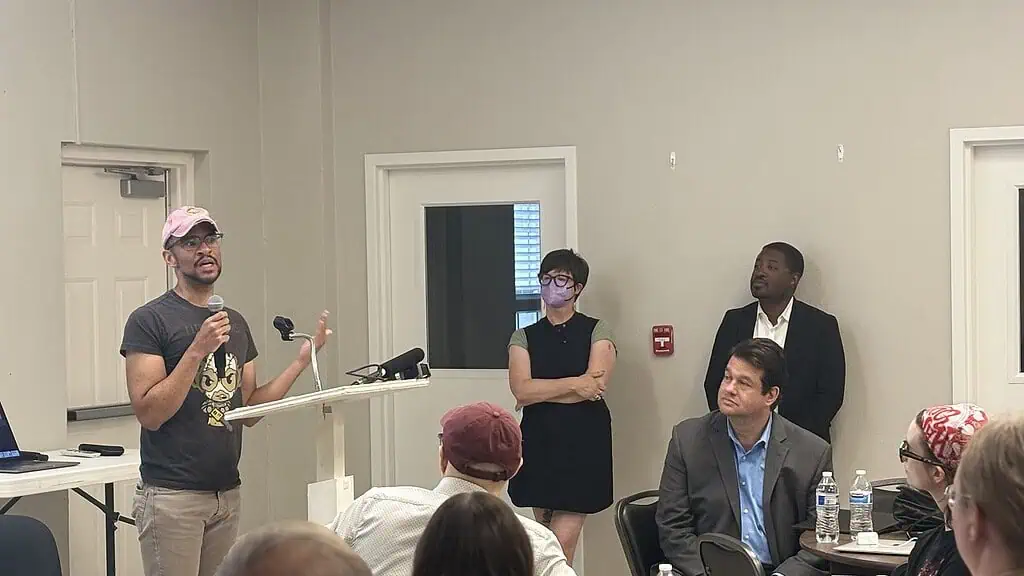
Ward 7 Councilman Camal Pennington was less firm at the time, saying that he would consider voting in favor only if some sweeping new oversight protocols are added, and only if there’s not enough support among other councilors for an outright ban, which he indicated would be his first choice.
“If there’s a path that says ‘ban,’ we’ll go down that road,” Pennington told Free Press, “and if there’s a path that says ‘we need to make amendments,’ then we’ll go down that road.”
Ward 8 Councilman Mark Stonecipher has supported the Flock camera system and ALPR use in Oklahoma City in the past, but when reached by Free Press via text message this week, he stopped short of declaring that same clear support ahead of the upcoming vote.
“I am still doing some research on the subject,” he said.
The last renewal of the Flock contract in Oklahoma City passed City Council in July of 2025 in a 6-2 vote, with only Cooper and Hamon voting against.

Brett Fieldcamp is the owner and Editor in Chief of Oklahoma City Free Press. He has been covering arts, entertainment, news, housing, and culture in Oklahoma for nearly two decades and served as Arts & Entertainment Editor before purchasing the company from founder Brett Dickerson in 2026.
He is also a musician and songwriter and holds a certification as Specialist of Spirits from The Society of Wine Educators.