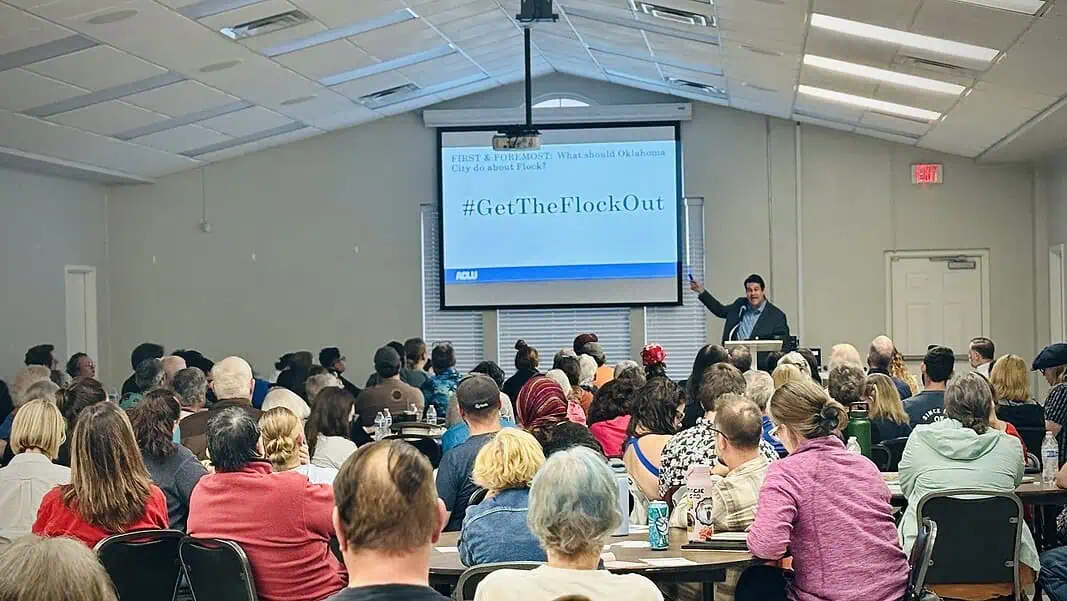

OKLAHOMA CITY – More than 100 city residents gathered at OKC’s Mayflower Congregational Church Wednesday to discuss and question the presence of automated license plate reader cameras used by Oklahoma City police, with concerns over privacy and oversight aimed mainly at one provider: Flock Safety.
And the City Council members in attendance said they’re preparing for a fight to remove the cameras from the city completely.

Flock’s pole-mounted traffic cameras and the AI-powered data network that connects them have been subjects of growing concern for months, since a local IT professional shared correspondence with City officials that shows practically no oversight, records, or guardrails for how OKC police are using the tech.
Free Press reported that release in March:
Now, as more than 50 cities across America have cut ties or terminated contracts with Flock over similar concerns, and as the City Council of OKC prepares to consider renewing their own contract with the company in July, some groups are sounding the alarm about what they see as a significant overreach of police surveillance.
Led by the ACLU of Oklahoma, along with a host of local activist and watchdog groups and some national-level support, Wednesday’s town hall event laid out the privacy and oversight concerns that have inspired their slogan, “Get the Flock Out.”
“I feel comfortable saying that Flock is the most problematic ALPR [automated license plate reader] company in the country,” ACLU’s national-level senior policy counsel Chad Marlow told the gathering in his keynote presentation. “Oklahoma City appears to be all in on Flock, and that is quite troubling.”
Concern over surveillance, AI network
In his presentation, Marlow laid out the various concerns that groups like the ACLU and residents across the country have voiced about Flock’s systems.
Most cities that contract with Flock claim to have specific, narrow uses for the cameras, such as Oklahoma’s stated use of tracking uninsured and stolen vehicles. But in many cases, all of the footage and identifying data collected by their cameras can be cataloged and shared through Flock’s nationwide AI-powered network and made available to agencies across the country, and in some cases, around the world.
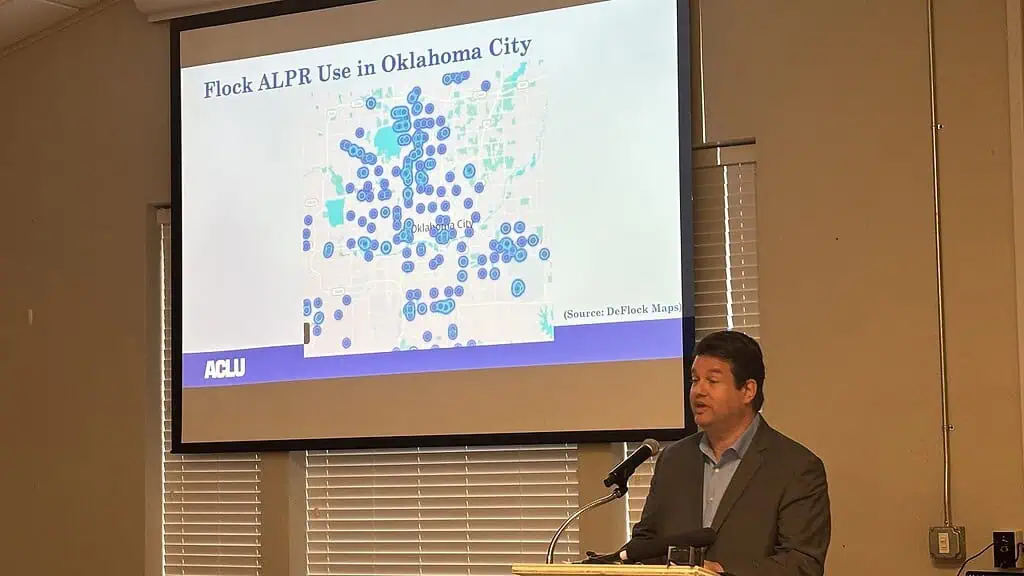
Marlow provided examples of how the standard 30-day period for which Flock stores and analyzes identifying data of vehicles is long enough to determine patterns in private behaviors for an individual, something the ACLU believes could be a violation of 4th Amendment privacy rights.
Information requests in other cities have even shown evidence of the camera networks being used by law enforcement officers to stalk women, track protesters, or Flock employees using live camera feeds from a children’s gym for internal training and demonstrations.
“Flock’s universal coverage goal, which the company repeatedly brags about, creates a dangerous chilling effect on the exercise of people’s constitutional rights,” Marlow said. “Even if a person is not violating the law, the threat of this constant, ever-present surveillance… will make people afraid to lawfully exercise their rights of freedom of speech, religion, and association.”
Lack of oversight in OKC
While watchdog groups, activists, and online influencers have successfully filed Freedom of Information Act requests in other cities to obtain records and logs showing unauthorized or questionable access to Flock’s AI network, no such records can be provided for the OKCPD’s use.
That’s because the contract signed between Flock and the City of OKC establishes no clear oversight or record-keeping of who is accessing the cameras and data in OKC or for what purpose.
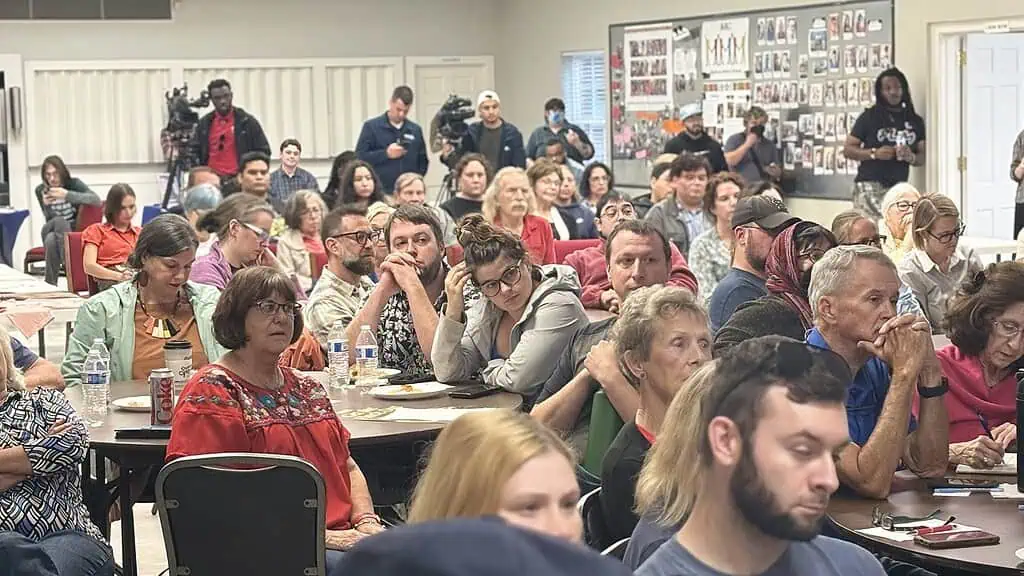
Following the event Wednesday, Marlow told Free Press that kind of lack of oversight is surprisingly common in cities that are contracted with Flock.
“It’s a weird thing,” he said. “If you’re thinking about using a new technology, you should make the rules, then use the technology, right? But almost every city does it the opposite. They use the technology, and then eventually they’re like ‘we should get around to making the rules.’ So you might think Oklahoma City is out of its mind with this, but it’s not uncommon.”
City Council ready for fight to end contract
All of those concerns were on the minds of the three City Council members that were in attendance Wednesday: Ward 2 Councilman James Cooper, Ward 6 Councilwoman JoBeth Hamon, and Ward 7 Councilman Camal Pennington.
Each gave brief remarks to the crowd early in the evening, and each stayed for the entire event, with Pennington and Cooper speaking to Free Press after to discuss what could be an uphill battle to either cancel the City’s contract with Flock or to insist on new oversight rules before its renewal in July.
“My preference is the maximalist position here,” Cooper told Free Press, saying that he plans to push for a complete termination of Flock’s contract with OKC, rather than simply pressing for stronger guardrails and oversight. “It’s hard for me to cosign on something like that. It just really is.”
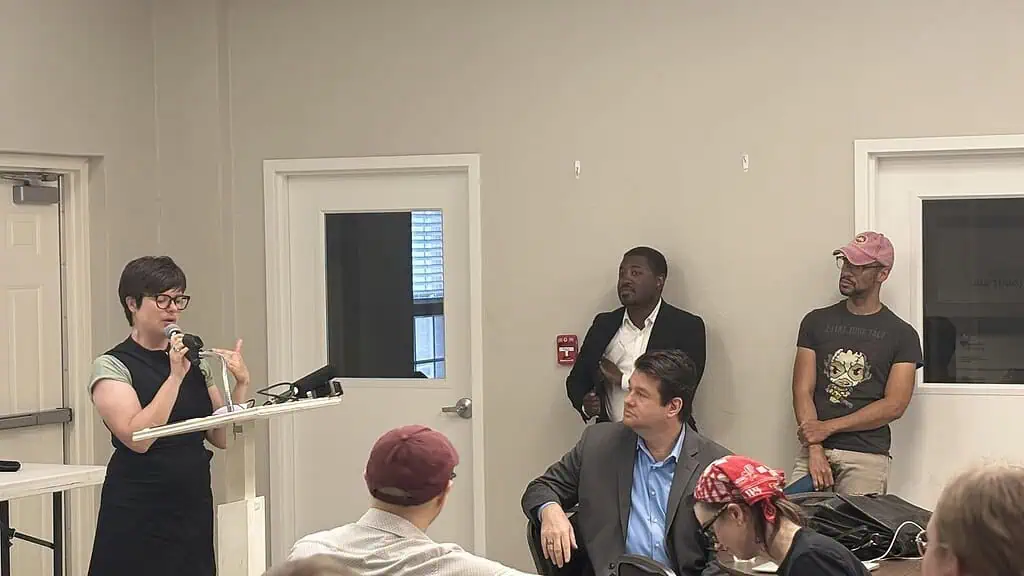
The councilors confirmed that Marlow had previously been at City Hall on behalf of the ACLU to provide City Council members and staff with a private briefing about the concerns and questions regarding Flock cameras before the event Wednesday.
Cooper, Hamon, and Pennington were all there, as was Mayor Holt’s Chief of Staff, Bailey Siber.
City Council members Carter, Avers, Stone, Hinkle, and Stonecipher all did not attend the briefing.
Though Pennington said his preference would also be a complete removal of Flock systems in the city, he expects that some other City officials will fight hard to keep them, and that he would push to create that missing oversight process if it looks like more council members will vote to renew the contract.
“It’ll probably be more intense conversations in the background,” he said. “But I fully expect that when all council members are briefed on some of these concerns and dangers, they’re going to want some changes at a minimum.”

Brett Fieldcamp is the owner and Editor in Chief of Oklahoma City Free Press. He has been covering arts, entertainment, news, housing, and culture in Oklahoma for nearly two decades and served as Arts & Entertainment Editor before purchasing the company from founder Brett Dickerson in 2026.
He is also a musician and songwriter and holds a certification as Specialist of Spirits from The Society of Wine Educators.