
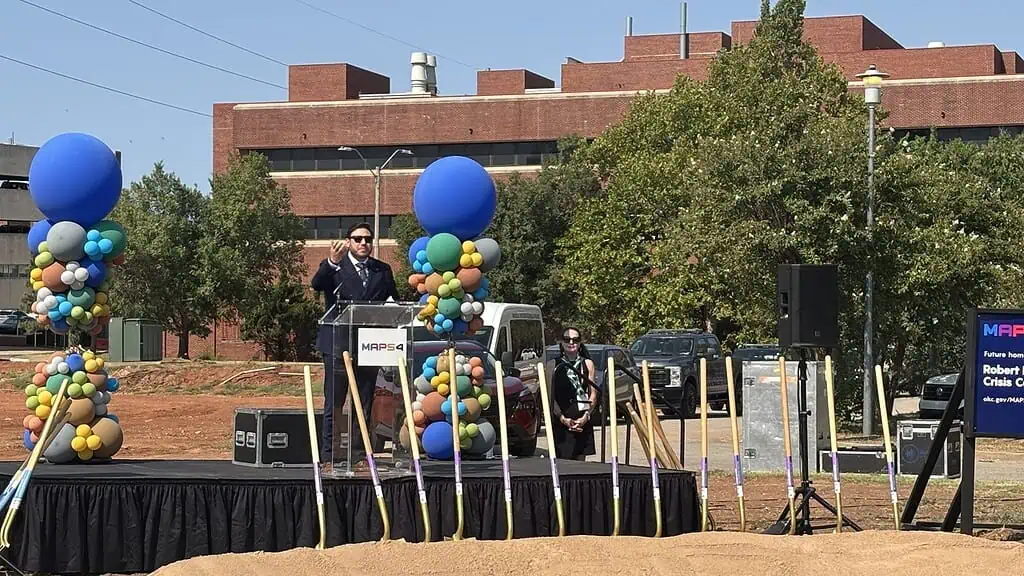
OKLAHOMA CITY – Oklahoma City’s summer of groundbreakings continued Monday morning as officials broke ground on the upcoming Robert Ravitz Crisis Center, a central project of the MAPS 4 package.
The new facility, named for longtime Chief Public Defender for Oklahoma County, Robert Ravitz, will provide a state-of-the-art, centralized service hub for mental health and drug crises, overseen by the Oklahoma Department of Mental Health and Substance Abuse Services (ODMHSAS) and utilized as a service anchor by the OKC Fire Department’s Mobile Integrated Health (MIH) unit.

Approved by voters in 2019 as part of MAPS 4, the Robert Ravitz Crisis Center represents a $12 million investment in expanded mental health services alongside another $2.6 million from the Arnall Family Foundation.
The new facility will stand at 1200 NE 13th Street, on the east side of the OU Health Sciences Center campus, replacing the existing Crisis Center building, which has fallen into some disrepair in its old age.
Monday’s event followed a summer-long slate of groundbreakings for other MAPS projects, including the long-awaited Clara Luper Civil Rights Center and the $121 million Multi-Purpose Stadium, as well as the ribbon-cutting on the new Diversion Hub headquarters, all in just over two months.
“Well, it’s the busy season for MAPS 4,” Mayor David Holt told the crowd Monday, a gathering that was notably smaller than other, higher-profile recent groundbreaking events, but no less enthusiastic. “It’s a lot of fun, obviously, to live in a city that’s willing to invest in itself, and that gives you these opportunities to have something to look forward to.”
‘A conundrum’
As Holt explained it, this new mental health crisis center is a response to one of the most common and repeated resident suggestions that he and the City heard while surveying opinions in the lead-up to the passage of MAPS 4 in 2019.
“We were polling people, and we were finding that every time one of the top three or four priorities that they had was mental health services,” he said. “Now, this is a bit of a conundrum for us at City Hall, because in 2018 and 2019, we had never invested $1, really, in mental health services. That’s not traditionally been the role of city government in Oklahoma.”

So to solve that conundrum and address the growing demand for more City involvement in mental health services, they turned to the (at the time) statewide leader for such services.
“I want to credit Commissioner Terri White, who was then leading the Oklahoma Department of Mental Health and Substance Abuse Services, for sitting down with us and finally giving us direction,” Holt said. “She said, ‘You should really have some more mental health crisis center beds. You should have some transitional housing, and you should have some kind of restoration center that is both addressing substance abuse and possibly more crisis center beds,’ and that’s essentially how we have moved forward, and that’s how we’ve arrived at this day.”
‘Different doors. Same promise.’
The aim of the new Robert Ravitz Crisis Center is to centralize mental health services of all kinds under one roof, easing and simplifying access to needed services for both OKC residents in crisis and first responders like MIH that might be transporting or assisting them.
“Whether someone walks in through the front door seeking help on their own, arrives with a family member, or is brought in by law enforcement or a mobile crisis team, they will be served, not because of how they arrived, but because they need help,” said Josh Anderson, interim director for ODMHSAS.
In a statement before the official groundbreaking, Anderson laid out the many different services, amenities, and considerations that have gone into the plans for the facility.
“Inside, you will find spaces intentionally designed to support treatment and recovery,” he said. “There are dedicated areas where community providers can meet patients before they leave, providing a warm handoff to ongoing treatment. There are improved clinical spaces that allow our teams to deliver trauma-informed care more effectively. Even something as simple as expanded kitchen and cafeteria matters because recovery is not only about medication and counseling. Sometimes healing begins with a hot meal, a quiet moment, and the reminder that you know these individuals matter.”
‘Compassionate justice’
While the primary focus Monday was on the capabilities and centralized care that service providers are looking forward to from the new Crisis Center, the speakers also paid significant tribute to its namesake.
“The Crisis Center is named in honor of the late Robert ‘Bob’ Ravitz, to recognize his three decades of service as the Oklahoma County Chief Public Defender,” said Teresa Rose, chair of the MAPS 4 Citizens Advisory Board, in her introduction to the event. “Mr. Ravitz’ entire professional career was dedicated to ensuring that the most vulnerable people in our community, those often struggling with severe mental illness, received compassionate justice.”

Ravitz’ own family was even on hand to champion this new addition to his legacy and to add their support to the center’s mission, including his young granddaughter, Abby, who spoke alongside her mother and even got to help with the groundbreaking.
“He was a great person,” she told the crowd. “This building will help a lot of people that aren’t feeling good.”

Brett Fieldcamp is the owner and Editor in Chief of Oklahoma City Free Press. He has been covering arts, entertainment, news, housing, and culture in Oklahoma for nearly two decades and served as Arts & Entertainment Editor before purchasing the company from founder Brett Dickerson in 2026.
He is also a musician and songwriter and holds a certification as Specialist of Spirits from The Society of Wine Educators.