OKLAHOMA CITY – What’s the actual virtue of living your life by a code? What’s the worth of giving your life for one?
When your philosophies, loyalties, and beliefs just lock you into a cycle of violence, punishment, and death, then what does it mean to try to break the cycle? Can it even be broken when it governs the entire world around you?
It’s easy to look at any costumed, period epic of Japan and its near-mythical samurai culture and presume a story of the razor’s-edge path walked by the samurai and the delicate virtuousness of those that would live and die by its code.
But “The Samurai and the Prisoner,” the intriguingly minimalist new feudal epic from the globally acclaimed Kyoshi Kurosawa – opening August 21st at the Oklahoma City Museum of Art – is decidedly not that kind of story.
Or at least it’s not that simple.
Based on the 2021 modern classic novel, “The Samurai and the Prisoner” opens to 1578, during the encroaching reign of terror of the murderous feudal warlord Oda Nobunaga. Castle lord Araki Murashige rebels, declaring his opposition to Oda and his refusal to turn over Arioka Castle or to command his army to fight for Oda.
When renowned tactician Kuroda Kanbei is sent as a messenger to convince Murashige to relent and to join Oda’s ranks, he’s arrested, and Murashige orders him imprisoned in the castle.
And that’s where it all goes off the rails, because according to all of the principles and codes of the samurai and of feudal war, Kanbei should be executed. Murashige should order his death, giving Kanbei an honorable, warrior’s end and providing reassurance that he’s not turned traitor to Oda.
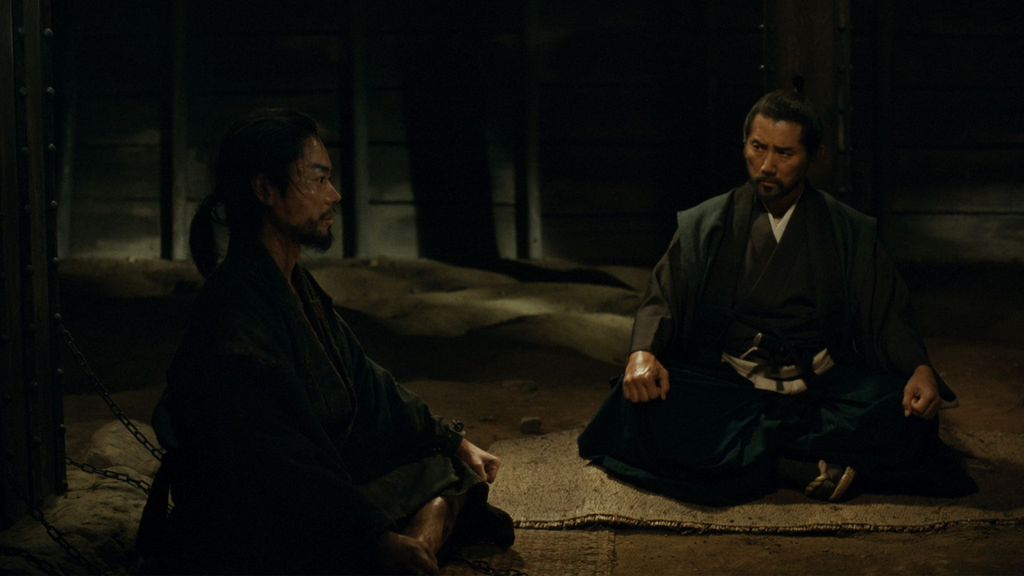
But Murashige refuses. He doesn’t intend to kill Kanbei. He doesn’t want to kill anyone. He’s sick of the killing, sick of the lords that use death for bargaining and strategy, and sick of the codes, orders, and religions that have so many convinced that killing is noble and that dying for a code is honorable.
Instead, he puts Kanbei’s valuable brain and indispensible tactical wisdom to work, trekking into the dungeon season after season to seek Kanbei’s wisdom in solving a series of murders around the castle.
People keep dying under Murashige’s watch, and the people around him all want to believe that it’s divine punishment or universal retribution for him breaking the codes.
But he knows better.
Kurosawa uses the killings as a signal of the unyielding, irrational fears and paranoias perpetuated by the endless codes and feuding religions, and he uses the logic and reason that solve them as an anchor signifying that Murashige may be right to refuse the kingdom’s customs. Even as that decision increasingly threatens to tear down the castle around him.

The shockingly prolific Kurosawa is probably more widely known for his dark, psychological horror offerings, like international breakouts “Pulse” and “Cure,” or for his ability to dig at the assumed niceties and expectations of domestic life in something like Cannes-winner “Tokyo Sonata.”
There’s a kind of clean sleekness to much of his work, and a general kind of modernity to the psychologies that he explores.
All of which would make it strange, then, for him to look all the way to the 1570s and to the often immoveable traditionalism of feudal era samurai culture, if not for the clear aim of deconstructing and outright questioning it.
Just like any of his modernized, present-set outings, Kurosawa is exploring the crushing expectations and social constructs that both define and demolish a culture.
But that cleanliness is still there. That calm, indifferent sleekness is still there.

“The Samurai and the Prisoner” is undoubtedly an epic. It spans entire seasons and encompasses the full weight of a nationwide kingdom at war. Its story sits at the center of a sprawling, generational conflict of hundreds of thousands, maybe millions.
But practically the entire film takes place within the hyper-minimalist walls of Arioka Castle, the war always outside in the distance (save for perhaps just one battle scene not far away.) And the castle itself is almost unbelievably sparse, mostly empty rooms of simple architecture and portent-laden space.
The whole story could easily be done on stage, in fact, as long as you have a cast as perfectly poised as the film’s.
As Murashige, lauded actor Masahiro Motoki is revelatory, tempering his exasperation at the endless calls for death and spiritual appeasement with a remarkable and easily believable heart. By the time you get a brief flashback detailing the origin of his distaste for death, you don’t actually need it, because he’s already convinced you that it’s simply because he’s a thoughtful, honorable man.

And Masaki Suda is his equal as Kanbei, as mysterious and cryptic as Murashige is blunt. But don’t mistake this for some kind of “Silence of the Samurai Lambs.” Kanbei isn’t Hannibal Lector, he’s a deeply loving father and a deep believer in his codes and the path that he’s chosen to walk. He shows the most outward heart, the most devastated emotion, and it’s his performance that offers a look at the soul-crushing effects of belief and blind faith.
It’s a strange film, there’s no question. It’s long. It’s mostly quiet and it’s never straightforward or easily parsed. It’s a series of “impossible” murder mysteries held together by unspoken questions of faith and the by the uncomfortable scars, traumas, and thin justifications of war and religion.
But it also may be one of the best and most compelling films of the year, a dense, mature, contemplative epic from a modern tonal master taking a big leap and landing with grace and humanity.
This is a must-see.
“The Samurai and the Prisoner” screens at the Oklahoma City Museum of Art Friday, August 21st through Sunday, August 23rd.
For times, tickets, and more, visit okcmoa.com.
Catch Brett Fieldcamp’s film column weekly for information and insights into the world of film in the Oklahoma City metro and Oklahoma. | Brought to you by the Oklahoma City Museum of Art.

Brett Fieldcamp is the owner and Editor in Chief of Oklahoma City Free Press. He has been covering arts, entertainment, news, housing, and culture in Oklahoma for nearly two decades and served as Arts & Entertainment Editor before purchasing the company from founder Brett Dickerson in 2026.
He is also a musician and songwriter and holds a certification as Specialist of Spirits from The Society of Wine Educators.