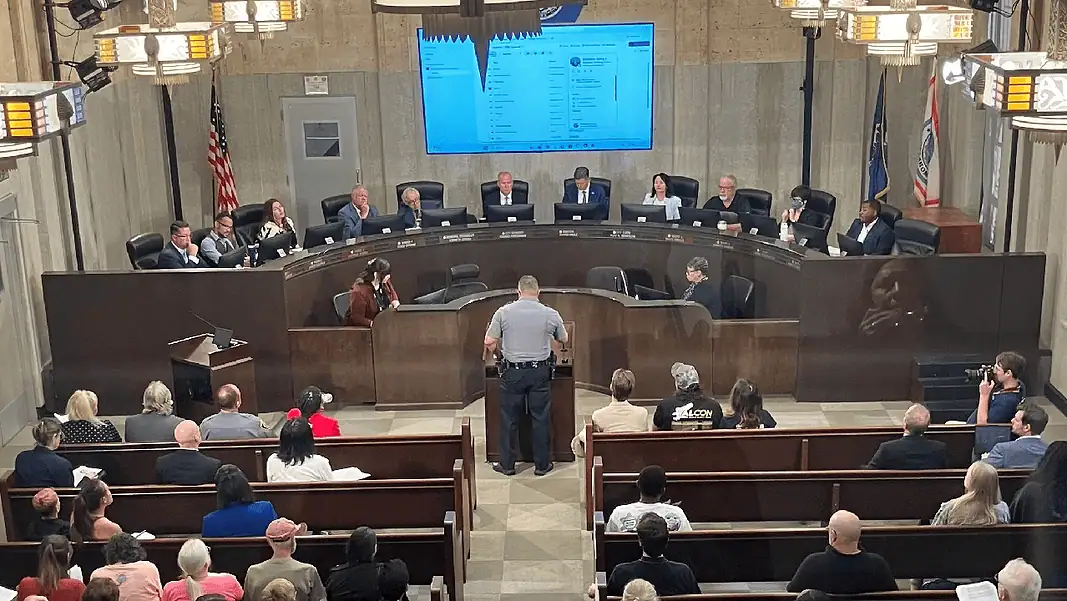

OKLAHOMA CITY – The Oklahoma City Council voted to renew its contract with controversial Flock Safety Tuesday, but imposed a strict collection of regulations and oversights on the company for the first time.
A detailed amendment was added to this newest contract renewal – the third such renewal since 2023 – seeking to address concerns of mass surveillance and privacy invasion from Flock’s nationwide network of AI-powered Automated License Plate Reader, or ALPR, traffic cameras.

With the notable absence of Ward 8 Councilman Mark Stonecipher, the council voted 5-3 in favor of renewing the amended contract. While five voted yes (four councilors plus Mayor David Holt), only one was vocal in their support of the contract.
All three councilors that voted against the renewal spoke openly about their reservations with Flock Safety, with or without the proposed new amendment.
Today’s vote will introduce sweeping regulations for the accessibility of Flock data by city police, putting OKC in step with other cities across the country aiming to regulate Flock, but stopping far short of the total cancelation and removal called for by numerous residents Tuesday.
Not a single resident spoke in favor of Flock Tuesday, and though many impressed upon Mayor Holt specifically to oppose the renewal, he voted in favor of the contract without addressing or speaking on the matter directly.
‘I understand the concerns’
Before the vote, OKCPD Chief Rron Bacy gave a full presentation to council explaining the new amendment’s oversights and regulations for investigators accessing the camera network and its data.
Free Press detailed those new regulations as laid out in an internal City memo earlier this month”
Ward 4 Councilman Todd Stone thanked Bacy for his presentation and offered a story about how the police recovered a car of his which was stolen to express support for the effectiveness of Flock cameras in police work.
“We’ve seen a lot of horrendous crimes where this has been able to have an impact,” Stone said.
“I understand the concerns, but I’ve also been one who’s gotten to see the benefit.”
Chief Bacy spoke in favor of renewing the contract with Flock only if the amendment was to be passed and with what he called “guardrails” and “safeguards” against misuse.
“The real question is: are the right guardrails and protections in place as we look at this technology?” Bacy said. “It must be used appropriately and for its intended purpose,” specifically mentioning regulations on the sharing and retention of data, expansion controls, sunsetting for the program, and permitted use.
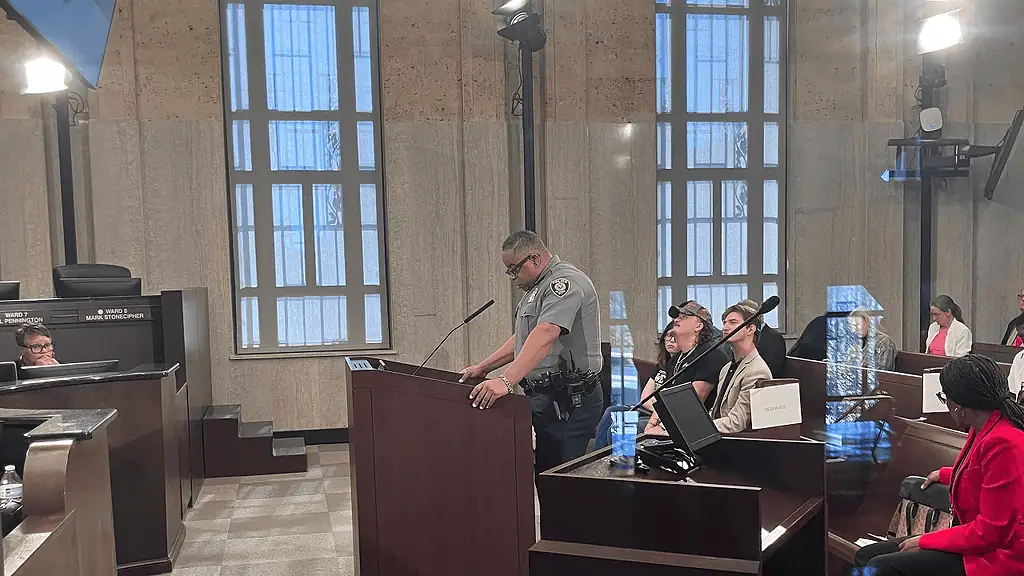
This is the first time in the three years that OKCPD has been under contract with Flock that such regulations have been put in place, leading to widespread concerns in recent months about a near-total lack of oversight for the system in Oklahoma City.
‘The naked eye’
Bacy was adamant that, despite the growing outrage against Flock and increasingly common reports of misuse and false identifications from their AI system, OKC’s ALPR cameras have been useful for local investigations.
“[Flock ALPR technology] helps our investigators prevent further harm and hold people accountable. All 90 of our cameras have been installed, and we’re not currently installing anymore,” Chief Bacy said. “The ALPR cameras do not capture video or audio. There’s no facial recognition or anything else that identifies anybody.”
While Flock says that physical features and characteristics are not recorded, the case has been made (including by national policy counsel for ACLU during an OKC event in May) that a month-long retention period for data is long enough to build behavioral profiles on lawful residents.
Bacy clarified that the new regulations will reduce that.
“We’re transitioning [from a 30-day deletion cycle] to an automatic 7-day deletion cycle” he said. “This aligns with best practices and reduces data held without limiting investigations.”
Bacy referenced two recent federal court cases as evidence that OKCPD’s use of ALPRs is completely constitutional and justified by U.S. law, arguing that a Flock camera is no more an infringement on privacy than a smart phone is. A Flock camera simply “captures what can be seen by the naked eye,” he said.

90 Flock cameras. More than a hundred others.
Though OKC’s contract with Flock allows for 90 ALPR cameras in the city, Bacy said, “there are more than a hundred other cameras” put up by private citizens or entities, a fact decried fiercely and repeatedly from the podium.
Ward 6 Councilwoman JoBeth Hamon asked Bacy about how the data from those cameras could be used by OKCPD.
“If neighborhood watch groups put up cameras, how do we know what those cameras are doing?” she asked, to which Chief Bacy responded that he’s not sure because they are private.
Hamon followed up by asking, “But you still have access to review them?” to which Bacy responded with a short “yes.”
‘Removing the humanity’
Hamon mentioned the recent case of an OKCPD officer “who used this for private purposes for potentially over a period of five months that was only flagged because of a complaint from a resident.”
The Councilwoman made clear her concerns with OKCPD seeking to renew the contract with Flock with or without the amendment, saying that Flock and other ALPR companies “have a documented history of lying, have an obvious profit motive that is not in the public’s best interest and is not in the interest of… our privacy and constitutional rights. That’s why I’m continuing to not be able to support this contract.”
Councilman Cooper for Ward 2 expressed similar reservations on police usage of Flock cameras, saying, “there must be a respect for police officers when it’s done right, but relying on robots and removing the humanity from detective work… seems unethical.”
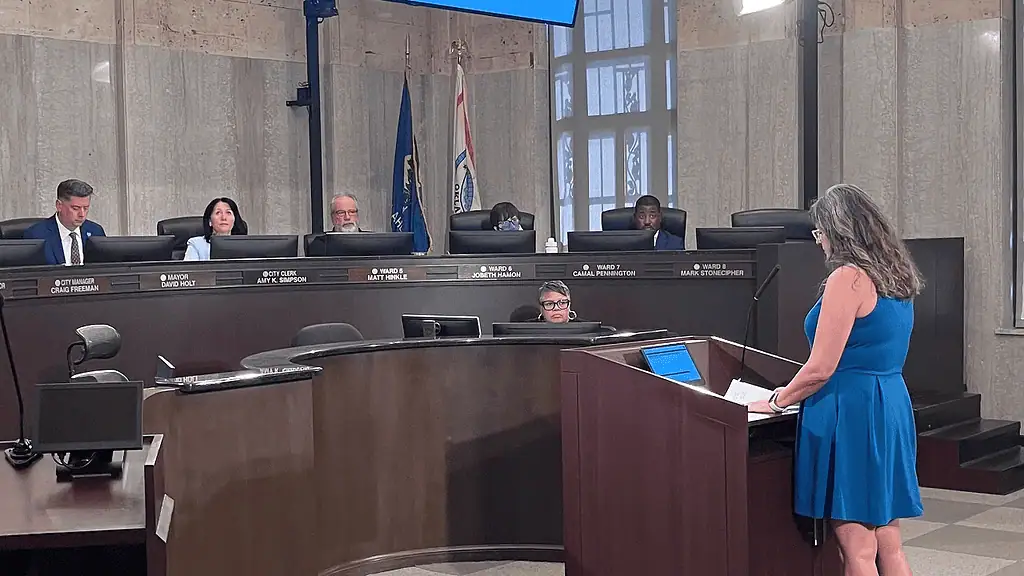
Public outcry against ALPRs and Flock continues
Widespread criticism of the proposed renewal and its regulatory amendment filled the chamber when time came for citizens to be heard. No one spoke in favor of the amendment to the renewal, focusing instead on calls to fully cancel the contract and remove the camera network.
Jarrett Freeman, an IT Specialist in OKC that has spoken with Free Press about Flock before, said “first, I want to give credit where it’s due: this amendment, it’s a start.”
“Whomever wrote this took a step in the right direction and walked right past the main point,” Freeman said. “[Flock] themselves stopped denying that this system is mass surveillance. The answer to ‘can we keep Flock if we add a couple of rules?’ is still ‘no,’ because every defense of this system is, and continues to be the same emotional anecdotes, a missing grandmother or a stolen car recovered. If the cameras are why the cases get solved now, tell me, how was every one of them solved before 2023?”
He said that all of the new regulations included in the contract’s amendment were actually suggestions from Flock to address the concerns and pushback that residents have expressed nationwide.
“Flock still owns the data under an irrevocable license,” Freeman said. “The remaining guardrails that were presented to us are Flock’s own settings. OKCPD did not put those guardrails in place. Flock did, under extreme pressure.”

Carly Heitland, an Organizing Manager with ACLU Oklahoma and member of Oklahomans for Privacy, spoke shortly after, bringing with her a stack of 2,200 signed petitions against Flock cameras in Oklahoma.
“I’ve never seen Oklahomans more unified on an issue,” she said.
Speaking to Free Press following the vote, Cole McAfee, Executive Director of Freedom Oklahoma, shared the belief that the new “guardrails” called for in the amendment are little more than marketing for Flock Safety.
“It seems like we are just using the same PR strategy that Flock is implementing nationwide,” McAfee said, “to pretend that we are actually doing something to address the very real and pressing concerns of constituents.”
The vote to renew the City of OKC’s contract with Flock Safety passed 5-3. The contract period retroactively begins July 1st, 2026, and continues until June 30th, 2027.

Tyler Smothers is a local, an Okie, and a poet living in Oklahoma City with his wife, Sadye, and their animals, Toby and Oscar.
He teaches medieval history and literature to 7th graders and loves everything from "Canterbury Tales" to "Mrs. Dalloway."