

OKLAHOMA CITY – The Oklahoma City Fire Department will soon be getting a new leader as the longtime Fire Chief prepares to step down after an historic tenure.
Fire Chief Richard Kelley announced in late July that he will retire from the Oklahoma City Fire Department (OKCFD) on September 30, 2026, bringing his nine years as chief of the department to a close.
In Kelley’s time as Fire Chief, he has seen OKCFD expand its size and its public service programs to serve a rapidly growing city, including the implementation of Fire Department ambulance services, its Whole Blood program, and OKC’s first Mobile Integrated Health unit for mental health crisis response.
Those innovations grew, in many ways, out of the COVID-19 pandemic, a period of hardships and challenges for the department that would come to define Kelley’s leadership and his lasting influence that’s already being felt among other Fire officials.
“Ever since COVID, we were trying to figure out how better can we serve this community as a whole,” OKCFD Capt. John Chenoweth told Free Press. “How can we serve them beyond that 911 call?”
Chief Kelley’s career with the OKCFD
Kelley began his service in Oklahoma City by serving with the Will Rogers Airport Fire Department for a year before joining the Oklahoma City Fire Department, where he has served since 1991.
Early in his tenure, Kelley served the city as a first responder to the Oklahoma City Bombing on April 19th, 1995.
He was a Corporal then, and according the Oklahoma City National Memorial Museum, “he was called in off-duty the day of the Bombing and worked a total of 11 days on the rescue and recovery efforts. He was assigned to the final team working the Bombing site when recovery operations were ceased.”
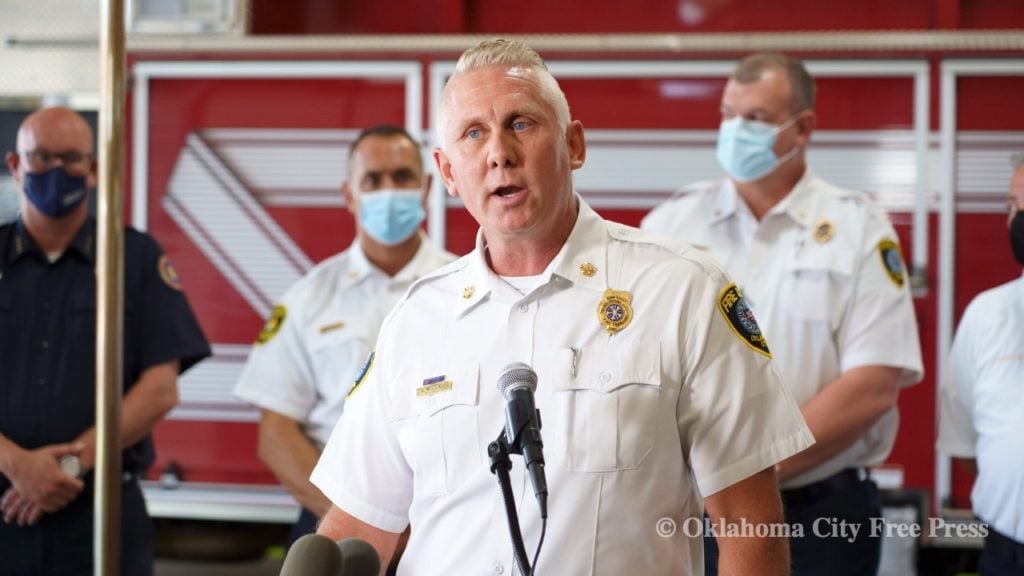
Kelley’s service in the Fire Department only continued from there as he rose through the department’s ranks.
“Throughout [Chief Kelley’s] career, he served in every rank before becoming the 21st Fire Chief in the department’s history in 2017,” a press statement announcing his retirement reads. “Under his leadership, Oklahoma City expanded to 38 fire stations, strengthened firefighter safety initiatives, enhanced emergency response capabilities, invested in specialized rescue resources, and embraced new technologies, including the department’s nationally recognized drone program.
Fire-based EMS, Whole Blood, and MIH programs
Since 2017, Chief Kelley has “helped guide the implementation of fire-based EMS transport, the Whole Blood Program, and Mobile Integrated Healthcare, further expanding the department’s ability to provide advanced, lifesaving care to the community,” according to the retirement announcement.
Capt. Chenoweth told Free Press that those programs were designed to create an emergency response network in OKC that reached beyond just 911 and police responders.
“It’s just that 911 can’t be a serve-all,” he said. “There have to be other things that we can do beyond that call.”
The Mobile Integrated Healthcare program (MIH) grew from this conviction.
“That’s why we came up with Mobile Integrated Healthcare,” Capt. Chenoweth said. “It helps not only the patient, but the family as well. As far as mental health emergencies, as far as [substance abuse] overdoses, [MIH] gets them connected to resources beyond just that initial emergency…Kelley was definitely a part of that.”
The Fire Department’s Whole Blood program – ensuring that Fire Department first responders can carry and administer whole blood for emergency transfusion – was another advancement authorized and championed by Chief Kelley.
“Study after study has shown that if you reach the patient and treat the patient on the scene quicker, the results are greatly improved,” Capt. Chenoweth said. “So if it’s a gunshot wound, a stab wound, a traumatic injury, and that patient needs blood, we are able to provide that blood on the scene, greatly improving the chance of survival.”
And since 2024, the Fire-based Emergency Medical Service (EMS) program has also sought to provide around-the-clock first-response medical care with its own fleet of ambulances, helping to cover shortfalls and staffing issues in other ambulance services like EMSA.
“We have four ambulances right now operating 24/7,” Chenoweth said, another step in their mission to “figure out ways to better serve this community.”

‘Always changing, always growing’
Since Chief Kelley took command of the Fire Department in 2017, OKC has seen its population grow by more than 80,000 people, rising to become one of the 25 largest cities in the United States.
That’s why Chenoweth said the Fire Department is, “always changing, it’s always growing.”
“Our department is funded by taxpayer dollars, you know, so all 38 fire stations, they’re owned by the residents [of OKC],” he said. “We’re trying to be as transparent as possible,” because, “everything we use – all of our stations we sleep in, all our rigs we use – are funded by taxpayer dollars.”

Tyler Smothers is a local, an Okie, and a poet living in Oklahoma City with his wife, Sadye, and their animals, Toby and Oscar.
He teaches medieval history and literature to 7th graders and loves everything from "Canterbury Tales" to "Mrs. Dalloway."