OKLAHOMA CITY – The Oklahoma City Museum of Art is using the power of cinema to spotlight some of the most eye-poppingly colorful and vibrant works of art of the 20th century with a newly curated showcase throughout December and January.
Dubbed “Technicolor Wonderland,” the two-month slate of midcentury movie masterworks was created to reflect the same eye for color and style on display in the museum’s current “Paul Reed: A Retrospective,” and like Reed’s work, the films selected pushed the early boundaries of color manipulation and design.
After decades as a largely black-and-white medium, cinema was turned on its head by the advent of the Technicolor process that allowed for full-color filming and projection, revolutionizing the way that audiences could experience stories on screen.
But while color film enhanced the immersion for moviegoing audiences, it also offered a massive new palette of expression and imagination for some of the era’s most towering creative figures, from Hitchcock to Fellini, with the greatest filmmakers of the 1950s and 60s fully embracing color to craft their visions.
OKCMOA’s Technicolor Wonderland has already presented fun crowd-pleasers like “Singin’ in the Rain,” “Gentlemen Prefer Blondes,” and the holiday staple “White Christmas,” but as this year comes to a close and a new one begins, they’ll be taking audiences into some more worldly, moody, and narratively rich Technicolor tales.
‘Good Morning (Ohayô)’ – December 27th
From Japanese cinema giant Yasujiro Ozu (the visionary behind “Tokyo Story”) comes this 1959 comedy of generational tension and childhood mischief.

“Good Morning (Ohayô)” (Shōchiku Films Ltd.)
When two young brothers in suburban Japan are told by their parents that they won’t be getting a television set, the boys take a vow of stubborn, defiant silence, attempting to teach their parents a lesson about the value of saying what you really mean and not wasting words on pointless niceties.
It’s Ozu’s satirical look at the shifting dynamics of the burgeoning media generation and the tensions being kicked up by the newly developing teenage and youth culture and the consumer appliance boom, all presented in Ozu’s deep, grounded earth tones and suburban coloration.
‘Written on the Wind’ – January 3rd
There’s no greater name in the annals of film melodrama than the great Douglas Sirk, the German director that blew the doors off of Hollywood in the 1950s with his torrid tales of unrestrained emotion, lurid sexuality, and jaw-droppingly expressive, rich color.
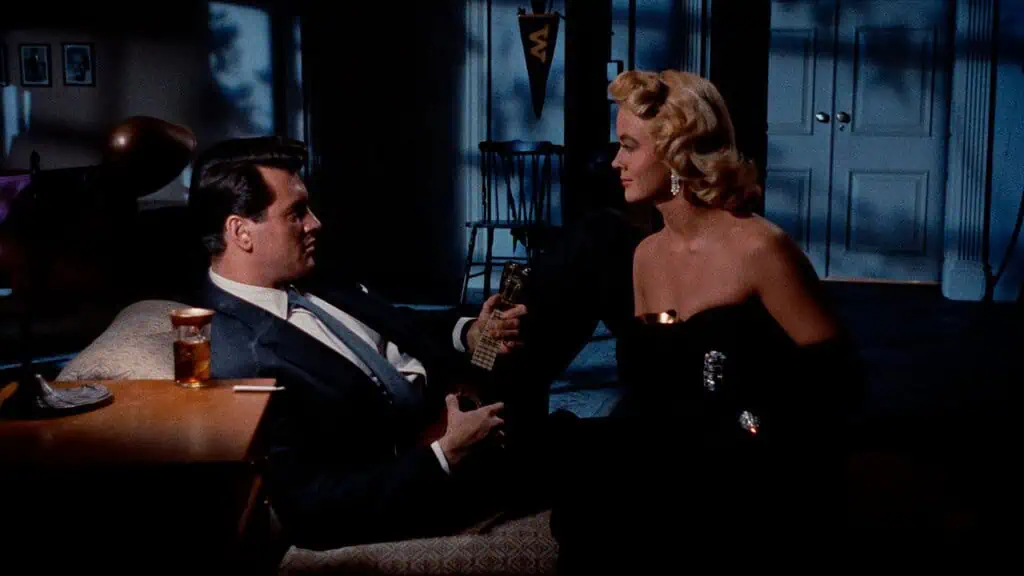
And 1956’s “Written on the Wind” features each of those elements in spades as it follows the boiling tensions and histrionic dramas of a filthy rich Texas oil family.
Featuring certifiable screen legends Lauren Bacall and Rock Hudson alongside a young Robert Stack and an Oscar-winning turn by Dorothy Malone, it’s a yarn of sex, fury, and madness on the upper rungs of wealth that might even put modern reality TV stars to shame.
‘Bigger Than Life’ – January 10th
Another quintessentially “50s” tale of heightened emotion and social upheaval, Nicholas Ray’s 1956 “Bigger Than Life” offers a shockingly prescient and even scarily sympathetic look at the early days of pharmaceutical addiction.
The incomparable James Mason stars as a mild-mannered schoolteacher and loving husband and father afflicted with a debilitating and possibly deadly condition causing agonizing chronic pain.

Agreeing to try the (at the time) experimental new cortisone, he gets a whole new lease on life that quickly begins to spiral as he starts abusing the medication and experiencing the worrying psychological effects of mood swings, irritability, increasing anger, and ultimately violence, directed largely toward his wife and child.
It’s an especially dark and emotional film for its time, featuring one of the most legendary performances of Mason’s career, and Ray’s saturated Technicolor and deeply expressionistic shadows heighten it all even further.
‘Marnie’ – January 17th
You can’t talk about true cinematic style in the 50s and 60s without mentioning Alfred Hitchcock, not only one of the greatest filmmaking figures of the era, but one of the most important filmmakers of all time.
When Hitchcock finally took to color, he utilized it just as creatively and expressively as he’d used black-and-white and dark shadow, employing color and hue to define his characters’ psychology and to create the highly stylized worlds and environments in which they moved.

All of which may be more than true than ever in 1964’s “Marnie,” starring Sean Connery as a smoldering and entitled publisher who takes an obsessive interest in Tippi Hedren’s titular Marnie, a mysterious, intriguingly unstable kleptomaniac that he’s convinced he can crack.
Hitchcock’s sets, sensibilities, and scintillating style are all on display here, with the director’s own eye becoming nearly a character of its own, and you’ll be able to experience it more vibrantly than ever in a brand new 4K transfer.
‘Juliet of the Spirits’ – January 24th
One of the era’s most visionary and groundbreaking creative forces, Italian filmmaking maestro Federico Fellini didn’t embrace color film in a feature until 1965’s “Juliet of the Spirits,” but of course, once he did, he brought every bit of his mastery to the medium.
“Juliet” is an epic of psychological exploration and spiritual discovery from the eyes and mind of Fellini’s own wife, Giulietta Masina, and it’s the perfect semi-surrealist vehicle for the director to open up his palette more completely.

Faced with the revelation of her husband’s affair, Masina’s character (naturally named Giulietta) embarks on a fantasy-laden journey of the soul, taking solace in friends and escapism in a dreamlike adventure through the city to finally find herself and her own desires.
It’s the kind of experience that just wouldn’t be the same without the expanded possibilities and expressions of that unmistakable Technicolor style, and that’s exactly what OKCMOA’s “Wonderland” is all about.
Catch Brett Fieldcamp’s film column weekly for information and insights into the world of film in the Oklahoma City metro and Oklahoma. | Brought to you by the Oklahoma City Museum of Art.

Brett Fieldcamp is the owner and Editor in Chief of Oklahoma City Free Press. He has been covering arts, entertainment, news, housing, and culture in Oklahoma for nearly two decades and served as Arts & Entertainment Editor before purchasing the company from founder Brett Dickerson in 2026.
He is also a musician and songwriter and holds a certification as Specialist of Spirits from The Society of Wine Educators.