

While driving to a homeless encampment site outside downtown Oklahoma City, Cryslynn Barnes described her job as pregaming the first steps to housing people experiencing homelessness. Sitting in the passenger seat next to her, Stephanie Risenhoover concurred.
Barnes and Risenhoover work on the street outreach team for Mental Health Association Oklahoma, one partner to Key to Home, Oklahoma City’s public-private collaboration that strives to prevent homelessness in the city.

The organization’s housing-first approach has proven successful, but the cumbersome, time-consuming process has posed challenges. There are several roadblocks on the path to housing, including the rental property inspection process to ensure habitability.
There were 75 people living at an encampment on SW 21st and Western. Sixty-five were housed through the Key to Home initiative, most in 30 to 60 days. Seven people took 60 to 90 days due to problems arising during the inspection process, said Amy Coldren, the advocacy and communications director for Mental Health Association Oklahoma.
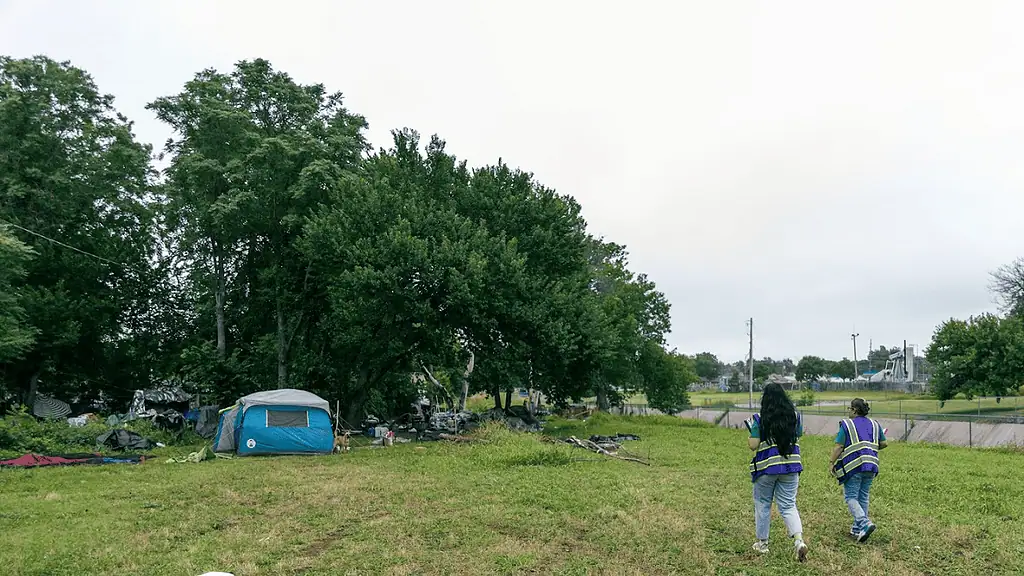
Advocates for people experiencing homelessness said the additional time spent outside heightens the risk for an unhoused person to fall further into chronic homelessness. Landlords said the inspection process is burdensome and can neglect tenants’ needs.
Deborah Jenkins, the Oklahoma Housing Finance Agency executive director, said the organization follows the United States Department of Housing and Urban Development protocol for the Housing Choice Voucher Program and cannot ignore HUD’s inspection protocol.
Steps Toward Housing
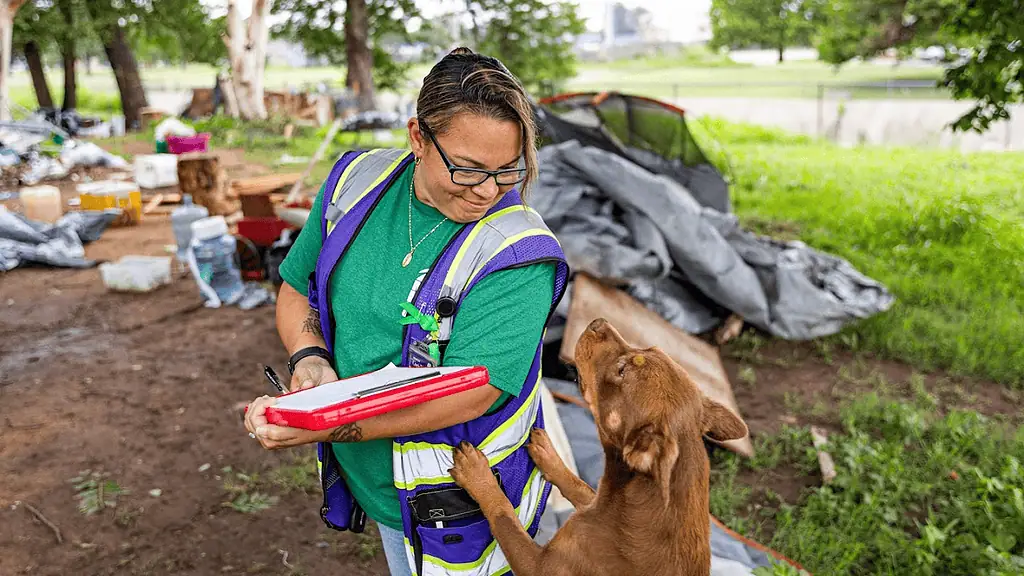
Street outreach workers, such as Barnes and Risenhoover, are often the first contact to get into the Key to Home program. The outreach workers typically don’t see the results, but they do see the barriers along the way to housing.
Barnes said minimal affordable housing and limited shelter space lead to people living outdoors and missing items, such as ID’s and birth certificates, can keep them there. And housing voucher inspections that fail can add an extra barrier.
The street outreach team tries to lower those barriers. That includes obtaining birth certificates, IDs, driver’s licenses, and Social Security cards to help unhoused people take the next step toward housing. And though nearly 50 organizations are working together through the program, resource constraints are another hurdle.
“The biggest hurdle that we have is resource constriction,” Jamie Caves, the Key to Home strategy implementation manager, said. “We are only serving a very small percentage of the population that needs supportive services.”
Caves said the system cannot keep up with the inflow. More people are falling into homelessness than are being lifted out.
The barriers play one part in keeping people unhoused, but an increase in people experiencing homelessness can be credited to the minimal affordable housing stock and evictions.
“We are really good at evicting people in Oklahoma,” Caves said.
She added that people leaving correctional facilities and young people in child protective services are also falling into homelessness.
“As the time you experience homelessness grows, so do the barriers,” Caves said. “We really want people that are experiencing long-term homelessness to decrease. We want to be thoughtful and focused on finding solutions and opportunities for them to move out of the homeless response system and back into stability.”
Caves said the housing inspections for the voucher programs are conducted before anyone moves into the unit, but sometimes it can be challenging. Still, she said it’s important.
“Everybody deserves decent housing,” Caves said.
Housing Inspections
Jenkins, the Oklahoma Housing Finance Authority executive director, said the inspections happen before anyone moves in.
“For Key to Home and other organizations that are trying to rapidly house the unhoused, we conduct pre-inspections,” Jenkins said. “The inspection is done before the family or individual is ready to occupy the unit; that way, there is not a delay.”
Both Jenkins and Holley Mangham, the communications director for the Oklahoma Housing Finance Agency, said that the inspections followed the federal guidelines set under the NSPIRE inspection standards and could not be altered.
Mangham provided Oklahoma Watch a list containing the most common reasons units don’t pass inspections:
- Electrical outlets six feet from standing water lack the required GFCI protection.
- Smoke alarms are non‑compliant.
- Electrical power is not active in units.
- Air conditioning systems are not functioning.
- Required appliances are missing.
- Interior and exterior excessive debris, and not in move-in-ready condition.
- Windows are broken or damaged.
- Pest infestation, including roaches and mice.
- Water heaters are missing the required safety discharge lines.
“What we can’t do is ignore HUD’s inspection protocol,” Jenkins said.
Joel Wilson, the Simple Property Management CEO, said that the housing vouchers and inspections can be difficult and time-consuming.
In Oklahoma, there’s a landlord shortage for people receiving rental assistance.
While the common reasons units do not pass inspections are large-scale problems, Wilson said, small things such as cracked light-switch plates can get flagged and need to be fixed before the next inspection.

“In the meantime, the owner is not getting the income, and the tenant is without a home or the ability to move from wherever they are currently at,” Wilson said.
Stephanie Newman, the street outreach and rapid response coordinator for Mental Health Association Oklahoma, said that small problems should not be disqualifying because shelter is still better than living outside.
Newman said landlord accountability also plays a part in the barriers to housing.
“If they are accepting subsidies, they already know what a subsidies inspection should entail,” she said.
Wilson said the process can be costly and leave a landlord questioning how necessary the repair is.
“Unfortunately, the thought that comes to their mind is, ‘Have we had our Section 8 inspection, and is it required by them?’” Wilson said. “Because, if we do this and then in three months our Section 8 inspection comes up, and they come up with another $800, $1200 worth of fluff that doesn’t actually need to be done, we could have put that into something meaningful and useful for the longevity of the property and the tenant.”
Housing Rehabilitation
The many barriers to housing boil down to the cost, availability and habitability.
Oklahoma lacks the necessary affordable and available housing, with an 84,125-unit shortfall, according to the National Low Income Housing Coalition.
That leads to renters being priced out, creating more homelessness. It also makes it more difficult for agencies to house people. And it makes it costly for landlords willing to rent to people with a housing voucher.
Shannon Entz, the housing strategy implementation manager tasked with implementing Oklahoma City’s affordable housing plan, said there’s progress toward increasing the quality incentives offered to develop and rehabilitate properties across the city.
She said that most homes that don’t pass inspection are likely aging and need safety measures and maintenance to make them habitable.
“There are a lot of good landlords and people who would like to be able to offer this, but they need help with the HVAC, or a new roof, or if there’s a leak, but they don’t have the cash to pay for the full amount to get that unit to an acceptable level for someone with a voucher,” Entz said.
Entz said Oklahoma City is developing programs to assist landlords in rehabilitating affordable properties, thereby expanding the city’s housing stock.

Aside from rehabilitation, development is also a priority for increasing the affordable housing stock. One property that recently opened is the Crossroads at NE Grand Blvd.
Entz said that money from the American Rescue Plan Act and the Oklahoma Housing Finance Agency helped develop the project.
“Our mission right now is to get more units, and they (Key to Home) will utilize them,” Entz said. “Our office focuses on the development of new housing as well as rehabbing existing homes, and they will make sure they make connections for people to find those units.”
Newman, the street outreach and rapid response coordinator, said that collaboration was necessary and that property owners should be involved.
“I believe that solutions can be found by bringing property owners to the table,” Newman said.

Republished in partnership with Oklahoma Watch under a Creative Commons license. Free Press publishes this report as a collaborative effort to provide the best coverage of state issues that affect our readers.

Jake Ramsey covers evictions, housing and homelessness. Contact him at (405) 370-3798 or jramsey@oklahomawatch.org.