OKLAHOMA CITY – Accessible transportation can be the difference between isolation and independence, but for many Oklahoma City residents with disabilities, driving or using standard public transit isn’t always possible.
That’s why EMBARK – the umbrella organization for multiple public transportation options across OKC and beyond – provides a wide range of accessibility services for seniors, foster youth, families in the child welfare system, and riders with disabilities across the city, providing access to schools, workplaces, grocery stores, and critical medical appointments.

True to their stated mission to serve everyone, EMBARK says they prioritize individuals who rely on their services most, offering reduced fares for some seniors and those with disabilities, and even offering free transit on the third Friday of each month and on voting days.
They’re even working to break down language barriers, with service information available in 27 languages and counting.
“We want to be accessible, we want to be safe, we want to be timely, we want to serve all citizens, regardless of their needs or economic situation,” said Dr. Marilyn Dillon, EMBARK’s Mobility Management Administrator and ADA Coordinator. “We’re focused on connecting people so they can improve their quality of life.”
Transportation programs for seniors
Most people came to understand social isolation, and its potentially devastating consequences, during the worst days of the COVID-19 pandemic, but for many seniors, social isolation continues to be a persistent daily reality.
“In seniors, [the social determinants of health] are absolutely critical,” Dillon told Free Press, “getting them out in the community, getting them to engage with other people, keeping them moving, making sure they’re eating healthy.”
EMBARK attempts to address these social determinants holistically.
Through grant-funding from the Oklahoma City Community Foundation, EMBARK transports seniors to Oklahoma County Senior Nutrition sites, where participants can share meals, play games, pursue creative hobbies, and learn from guest speakers, as well as providing seniors with weekly grocery shopping trips and rides to and from medical appointments.
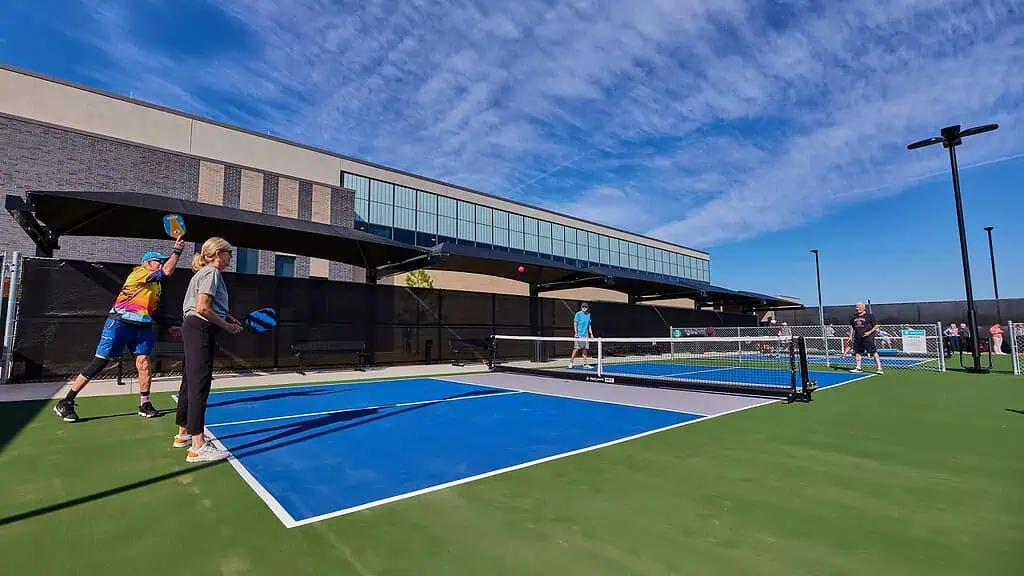
Health and wellness access is another critical gap for residents 65+ who no longer drive, since traditional insurance, Medicare, and Medicaid typically do not cover transportation to fitness centers, so EMBARK provides transit to YMCA locations and other wellness organizations, where participants can exercise and connect with community members beyond their immediate neighborhoods.
Together, these programs give seniors in OKC meaningful opportunities to thrive physically, emotionally, and socially.
Of course, none of this happens without strain, especially due to federal funding cuts.
For EMBARK, raising transportation fares to offset monetary gaps isn’t an option they are willing to consider, since many riders are low-income. It’s a tension that persists for EMBARK, as well as nonprofits and public services broadly, as costs continue to rise industry-wide.
Transportation for vulnerable families and youth
For many OKC parents navigating the child welfare system, lack of transportation can create significant barriers to completing court-ordered services and reuniting with their children.
In 2018, EMBARK entered the Transportation Innovation Grant Challenge with the goal of improving child welfare outcomes across Oklahoma County. Working in partnership with the Community Transportation Association of America and the Oklahoma Transit Association, EMBARK won.
The programs that emerged proved to be life-changing for families in Oklahoma County, with the share of families successfully reunited rising from a previous average of 35% to 63%.
More recently, EMBARK has also partnered with Pivot‘s Transitional Living Program to provide accessible transit services for foster youth ages 17 to 24. As these young people age out of the foster care system, they often lose access to critical supports almost overnight.
Before the EMBARK-Pivot collaboration, roughly 66% of foster youth experienced some degree of homelessness. Many were also trapped in low-wage jobs with little room for advancement. Now with access to reliable public transportation, many participants’ situations have stabilized, opening doors to better job opportunities, higher pay and benefits, and stronger long-term outcomes.
These realities, affecting OKC residents across generations, have led EMBARK to invest in professional development training for staff in trauma-informed approaches and personal empowerment.
“We want to make sure that everybody in our group is trained in the science of hope, so that we can help people maintain their willpower, set some goals, and look for pathways to get there,” said Dillon. “[Drivers that run our mobility services] also go into advanced, trauma-informed training. They have to be able to recognize that someone’s in trauma or in crisis, and how to de-escalate, how to use people-first language to make them feel seen and heard.”
Accessibility and EMBARK Plus Paratransit
When the Americans with Disabilities Act (ADA) was passed in 1990, federal law required paratransit service within 3/4ths of a mile of major bus routes. However, EMBARK Plus is available throughout the city limits, which goes well beyond the federal requirements of 3/4ths of a mile from existing bus service.
“Just because someone lives further out from the core doesn’t mean they shouldn’t have access to this beneficial [transportation] service, so they can improve their quality of life and engage with the community,” said Dillon.
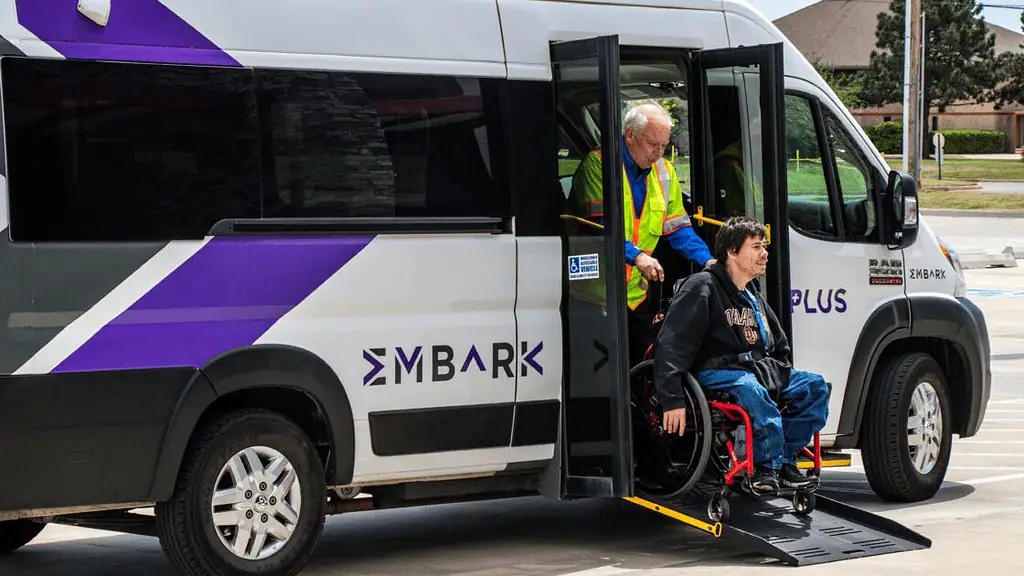
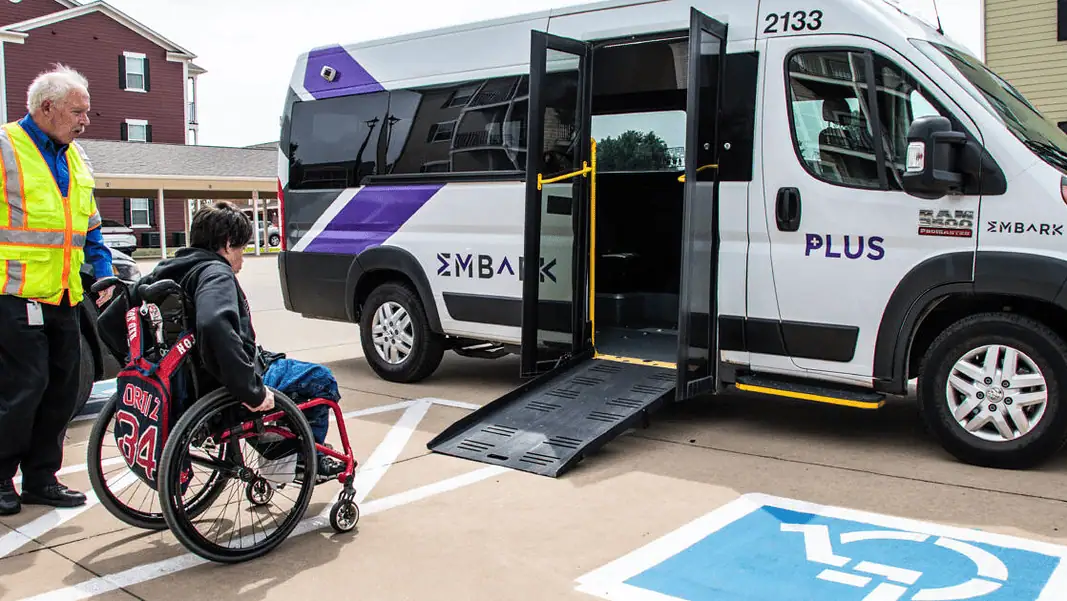
Now, in 2026, EMBARK provides an independence-centered boarding system for wheelchair users. Riders can back their chair into an automatic securement device and then press a button to engage arms that hold the chair in place while the vehicle is in motion.
“A lot of our individuals with disabilities that use wheelchairs absolutely loved the introduction of that, because it does give them more independence,” said Dillon. “They don’t have to have the bus operator help them secure the chair to the vehicle. It’s been very exciting.”
EMBARK Plus vehicles also feature ramp loading, featuring a ramp that extends from the vehicle so that wheelchair users can board independently. Operator assistance remains available for riders who need it and all EMBARK drivers are extensively trained to provide assistance for individuals with disabilities.
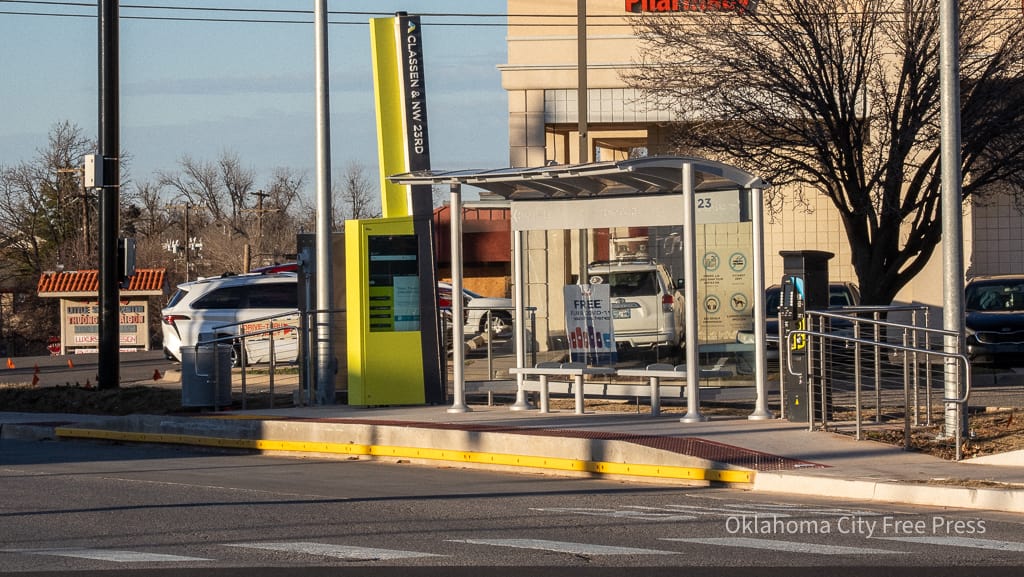
An additional accessibility feature is the new Bus Rapid Transit’s (BRT’s) level boarding platform, which allows a wheelchair user to roll directly onto the vehicle, back into an automatic securement system, and independently secure themselves in place.
‘Ahead of the curve’
“In terms of [accessible design], I think Oklahoma City’s ahead of the curve, frankly,” said Dillon. “We have the MAPS project pushing all these new sidewalks. We are building 500 new bus shelters that are connected to the sidewalks, so they’re fully accessible all over downtown. You’re seeing these lovely, signalized intersections with verbal crossings for people with disabilities.”
For EMBARK, every service and program is shaped by an equity and disability accessibility framework, built on the conviction that a city that includes everyone is a stronger city for all.
For more information about EMBARK’s transportation options, programs, and services, visit embarkok.com.

Erin Schalk serves as a professional writer, visual artist, voice narrator, and accessibility-centered educator. She is the recent recipient of multiple Writer’s Digest awards and the Armed Services Arts Partnership’s National Scholarship. She has also received a Best of the Net nomination. Schalk’s work has appeared in Wordgathering, Stirring Lit, Parentheses International Literary Journal, The Petigru Review, and numerous other publications. She also received her MFA from the School of the Art Institute of Chicago.