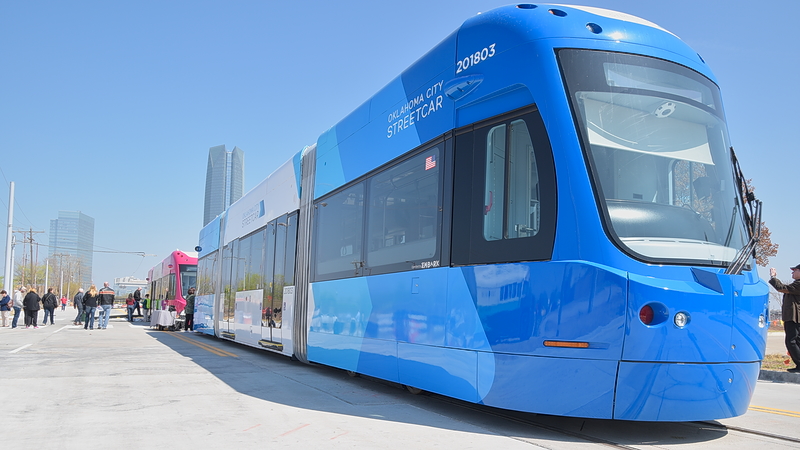

OKLAHOMA CITY – The Downtown OKC Streetcar will remain fare-free indefinitely following the rousing success of a pilot program designed to test whether removing the fare would increase ridership.
The resolution permanently waiving the fare was announced Friday by the Central Oklahoma Transportation and Parking Authority (COPTA) – the board that oversees EMBARK , the City of OKC’s public transit authority – and went into effect immediately.
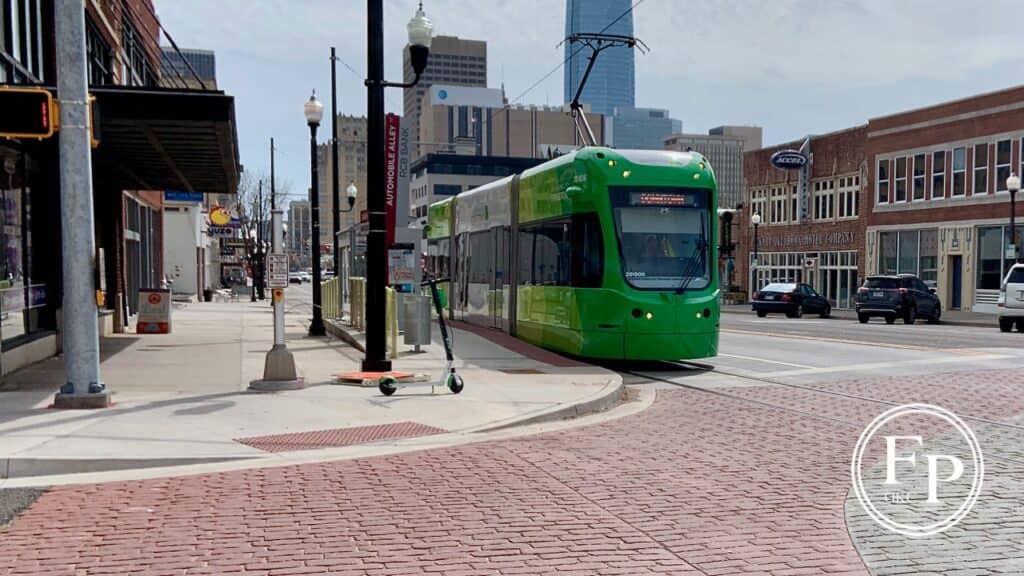
The decision for the streetcar to go “Zero Fare” was made after a months-long fare-less pilot program launched in January that quickly proved overall rider numbers and usage would skyrocket on the service without a fare.
During that time, ridership reportedly rose by up to 74%, with June of this year recording the highest monthly number of riders in the streetcar’s history.
“We’re pleased to see these positive results from the ridership analysis and to create a Zero Fare OKC Streetcar system for our residents and visitors,” said Jesse Rush, Director of EMBARK in a press statement Friday. “As our city continues to invest in projects and host major events coming to downtown Oklahoma City, the streetcar can improve downtown circulation, help ease traffic congestion and boost economic activity for downtown businesses.”
Mayor David Holt has recently signaled a commitment to significant investments in public transit across the OKC metro, even dedicating a large portion of last month’s State of the City address to touting the proposed ONE Transit plan, and he celebrated the new fare-free streetcar in a lengthy social media post Friday.
“From this day forward, the OKC Streetcar will no longer charge fares,” Holt wrote. “Enjoy this service and enjoy our fantastic downtown!”
He also acknowledged that the $135 million streetcar project hasn’t been quite the success that the City hoped since its launch in 2018, blaming the perceived resident aversion to the service on the fare.
“Since the streetcar’s inception, there has been an inherent tension in its operations,” Holt’s post reads. “The fare was not high, but the level of hassle was. People understandably didn’t want to spend five minutes at a fare machine or downloading an app for a five-minute ride. The usage of streetcar is very different than the usage of other public transit, but we charged fares in both cases.”
He expressed his hope that the now fare-less service will encourage more riders jumping on and off more easily to ride for short distances around Downtown, a trend already proven by the Zero Fare pilot program.
But the bulk of Holt’s post was dedicated to a detailed and surprisingly candid championing of free public services and the need for more government-offered services that aren’t expected to turn a profit.
“People often say they want to run government like a business,” he writes, “but the reality is that most government services don’t create profit for the provider, or even break even.”
The return seen from fares in a public transit system, he explains, is often just a small fraction of the system’s true operating cost, and one that can, in some cases, be covered by other City revenue without charging riders.
Holt discussed many of the same points just after his State of the City presentation last month, when asked by Free Press if he would consider following some other American cities that have made their transit systems entirely free for riders.
“Every public transit system is subsidized, but so too are the roads,” he said. “I mean, because we charge fares, people tend to get it in their mind ‘well, I guess that’s paying for the service,’ and it is usually paying for like 10% of the service. So those cities – which it’s a very small number that have decided to make their services free – are not necessarily giving up the entire revenue stream that is funding the system.”
According to Holt’s post Friday, the measure of success for a public service shouldn’t be a dollar amount or a financial return on investment, but the enthusiasm with which the public engages with the service.
The Zero Fare pilot program proved that the public was significantly more enthusiastic about the streetcar with no cost requirement.
The hope is that now that enthusiasm will continue indefinitely.
“In government, we don’t measure the success of our services by the profit they turn, because they never have and they never will,” Holt’s post reads. “We measure them by their usage. If the community is using it, it has value.”

Brett Fieldcamp is the owner and Editor in Chief of Oklahoma City Free Press. He has been covering arts, entertainment, news, housing, and culture in Oklahoma for nearly two decades and served as Arts & Entertainment Editor before purchasing the company from founder Brett Dickerson in 2026.
He is also a musician and songwriter and holds a certification as Specialist of Spirits from The Society of Wine Educators.