OKLAHOMA CITY – With the holiday season ramping up, much of the filmgoing world has their eyes on two things: feel-good holiday fare and the growing field of major awards contenders.
But as the temperatures cool and the year nears its end, now is also a time for reflection and for feeling the weight of the year’s loves, losses, and lingering memories.
And that means that there are also plenty of viewers looking for the kinds of films that capture the emotion, the reality, and the deep, longing humanity that so many feel during this time of year when an absence can cut deeper and the grief can hit harder than ever.
If that’s a mood that you find yourself in this season, then you can rest assured that some city cinemas will have the stories that you need to help carry or confront those feelings.
So grab your tissues, because we’re getting’ sad with it.
‘Blue Moon’ – Oklahoma City Museum of Art – December 5th through 11th
No one can make an intimate, internalized character study informed by its own time period and setting quite like indie stalwart Richard Linklater.
Each scene throughout the groundbreaking “Boyhood” is as much a snapshot of a time and place in America as it is of the adolescent years of growth, and each installment of his masterful “Before” trilogy utilizes its worldly setting and its place in time as a catalyst for its emotional turmoil.
So there’s perhaps no other filmmaker that could so naturally and quietly tackle the inner squall of one of America’s most influential 20th century artists at a precise and pivotal moment of 20th century American history.
That’s what we get with “Blue Moon,” Linklater’s new single-evening portrait of Lorenz Hart, the legendary Jazz Age lyricist whose immortal songs make up a significant chunk of the Great American Songbook, including “The Lady is a Tramp” and the monumental “Blue Moon” itself.

Hart rose to global acclaim through his wildly productive partnership with Richard Rodgers, but by the early years of the 1940s, Hart’s hard drinking and cracking seams had led to Rodgers teaming instead with Oscar Hammerstein in what would be perhaps the most lauded creative partnership in Broadway history.
And that’s where “Blue Moon” lands, settling on the great Ethan Hawke as Hart in New York City on the 1943 opening night of Rodgers and Hammerstein’s brand new “Oklahoma!,” a play that would shortly change the entire landscape of the stage musical.
Told in real-time during that fateful night just months before Hart’s tragic death to alcohol-related pneumonia, Linklater’s film aims to capture the full, complex spectrum of emotions within a man watching the world running away to change without him. The war is still on, the world of Broadway is morphing into a brand new monster, and his own lifestyle has pushed away his friends and his own chance at that stratospheric success.
And then of course, there’s the music.
The soundtrack is built primarily on solo piano renditions of Hart’s own songs and other classics from the period performed by Graham Reynolds, imbuing the ambience of the film with the same indelible melodies that live every moment in Hart’s mind.
Because nothing says “winter longing” quite like a solo piano in a late-night bar.
For more, visit okcmoa.com.
‘Rental Family’ – Now Playing
Since the unexpected and wholly welcome career resurgence that saw him rise all the way to an Oscar win for “The Whale,” once-forgotten star Brendan Fraser has played it pretty smart by leveraging his awards gold toward more unassuming and supportive roles rather than attempting a jump right back into the A-list fray.
He even enjoyed some solid screentime in the Oklahoma-filmed “Killers of the Flower Moon.”
But now he’s returning with his first full-on leading role since his Oscar win with “Rental Family,” from Japanese writer/director Hikari.
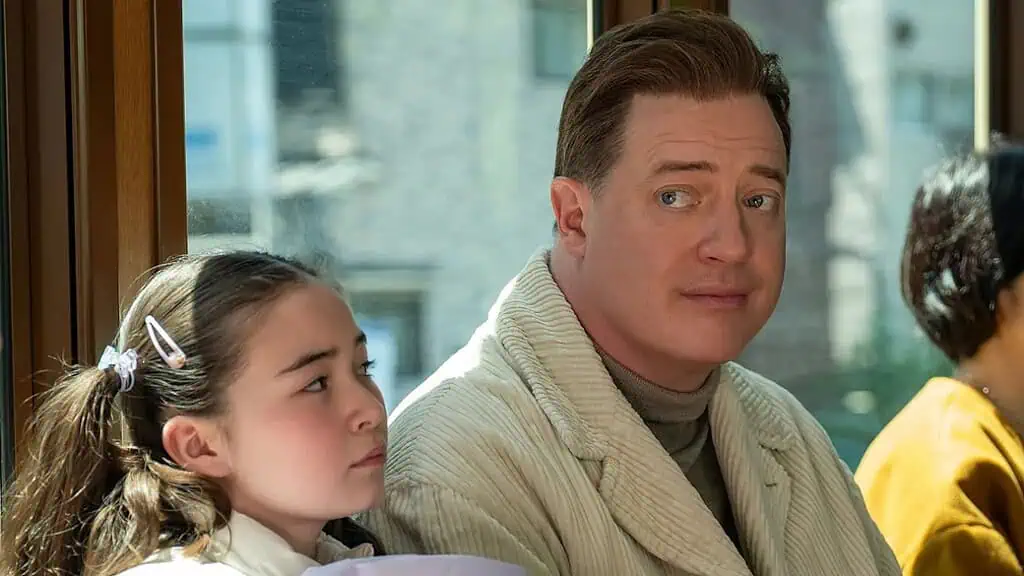
Fraser stars as Phillip, a struggling American actor in Tokyo that takes a job as a for-hire stand-in for families that are missing absent members, needing some extra help or some extra roles filled, or presenting themselves less-than-honestly to skirt social traditions.
Along the way, of course, Phillip finds that committing to these fake connections can be a fast track to forging very real ones, but also that there are so many lost and lonely people that just need someone willing to step in and care about them, even if they’re pretending.
It’s all bound to play to Fraser’s strengths as an affable and finitely likable guy, the kind of guy that you’d be happy to pay to play your husband or your dad, and it looks to say some very real and honest things about the need for connection and genuine human interaction.
And it also doesn’t hurt to have an all-original new score by Alex Somers and Jonsi Birgisson, singer/guitarist of Icelandic post-rock gods Sigur Ros (full disclosure: my favorite band on Earth,) whose music can be so cinematic and emotionally evocative that it’s almost like cheating.
‘Blue’ – Oklahoma Film Exchange – December 1st
Would you believe that a single, unchanging blue screen projected for 80 minutes could be the basis of something devastatingly emotional and tragically pointed?
If yes, then you may have already seen Derek Jarman’s 1993 convention-shattering final film “Blue.” And if no, then you probably need to.
Jarman was a foundational figure in the worlds of highly expressive, avant-garde cinema, queer filmmaking culture, and gay rights activism, particularly throughout the 1980s when his native England was facing dire, homophobic legislation under Prime Minister Margaret Thatcher.
By his early 50s, Jarman was battling AIDS, and sought to produce his final film as a testament to his life, his community, and his identity, and to dreaming and to art itself.

With his sickness rendering him mostly blind, Jarman created “Blue” to be just that.
The film’s runtime features only a static shade of blue on screen for 80 minutes with a soundtrack of narrators – including screen legends Nigel Terry, Tilda Swinton, and Jarman himself – dissecting dreams, daily life, questions of existentialism, and ponderings of health and death.
Beneath the narration is a score featuring equally experimental and boundary-smashing musical artists, including the band Coil and ambient mastermind Brian Eno, further cementing the impact that Jarman made on the full artistic community of Great Britain during his lifetime.
There had never been anything quite like it in film at the time, and arguably there’s still never been anything so piercing in its uncompromising vision of mortality or more poignant in its commitment to simplicity.
For more, visit oklahomafilmexchange.com.
Catch Brett Fieldcamp’s film column weekly for information and insights into the world of film in the Oklahoma City metro and Oklahoma. | Brought to you by the Oklahoma City Museum of Art.

Brett Fieldcamp is the owner and Editor in Chief of Oklahoma City Free Press. He has been covering arts, entertainment, news, housing, and culture in Oklahoma for nearly two decades and served as Arts & Entertainment Editor before purchasing the company from founder Brett Dickerson in 2026.
He is also a musician and songwriter and holds a certification as Specialist of Spirits from The Society of Wine Educators.