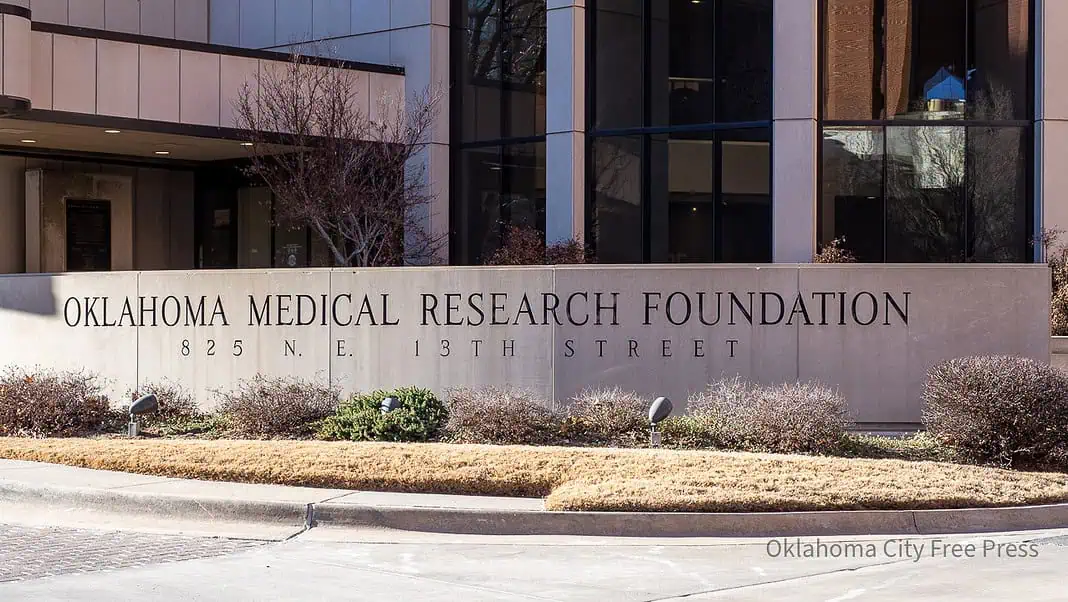

OKLAHOMA CITY – With federal funding for scientific research still wracked by confusion, and with unprecedented, ideologically driven oversight still hampering grant approvals, science community leaders say that progress has remained slow and unsteady, even as Oklahoma enters severe weather season and OKC continues driving new medical research.
Now, on the eve of a nationwide protest event led by activism outlet Stand Up for Science – with a satellite rally planned for OKC Saturday, March 7th – science leaders are opening up about the importance of raising research and technology funding as a central political issue.
“Especially when it feels like it’s a long shot, that’s when the noise matters the most,” Stand Up for Science CEO Colette Delawalla told Free Press by phone Wednesday ahead of this weekend’s national event.
“A lot of people write themselves out of having their voice heard and think ‘well, my Congressperson or my Senator doesn’t agree with me,’” Delawalla said. “But really, until 2025, science really wasn’t a partisan issue, and I actually think that constituents have way more power here than they often think that they do.”
Research in limbo
That may especially be the case in Oklahoma, where the volatility of our weather drives national meteorological research through Norman’s National Weather Center and biomedical and tech development has bolstered investment in places like OKC’s Innovation District.
But with federal grant funding still reeling from the chaos of early 2025, when grants were being unpredictably frozen, ignored, or defunded under direction of the Trump administration, even local research leaders say that potentially life-changing developments have remained in limbo.

“It’s been a big challenge,” said Dr. Elaine Hamm, the OKC-based CEO of pharmaceutical accelerator Ascend BioVentures and an executive with Cadenza Bio. “The market has stabilized to some degree on the investment side where usually grants would fill that gap, but the grants themselves have been very, very challenging.”
Cadenza Bio as been developing new breakthrough treatments for Multiple Sclerosis in recent years, but have seen their progress halted by substantial cuts and holdups for federal grant funding.
“We submitted a grant and got really great scores, but in the program we submitted to, they only funded about 1% of the grants this time and we just weren’t one of them,” Hamm told Free Press. “So right now, we’re kind of in limbo, because we’re at a point in our program where there’s nothing small and incremental that we can do. The next steps are making the drug, doing big safety tests, and then going into a clinical trial.”
‘Banned’ terms
On top of being forced to compete for much smaller pools of grant funds, researchers have also spent the last year sweating over specific words and phrasing in their own grant proposals following reports of federal reviewers “banning” terms they’ve deemed ideologically opposed to the administration’s goals.
Those terms have reportedly included “diversity,” “equality,” and “Covid-19,” among potentially hundreds of others going as broad as “Black,” “women,” and even “rural water.”
But there doesn’t appear to be much consistency to when those terms are disallowed in grant applications and when they are approved.
“I work a lot in women’s health, so that was a big concern for us, ‘can we use the words women and females?’ and we had to think about that as we wrote our grants,” Hamm said. “But then it didn’t seem to hurt our grant when it moved through, and it could still potentially get funded. So I don’t know.”
Climate crisis
But one area of research that remains on high alert, and an area of particular interest for Oklahomans, is weather science.
With our state’s tendency to produce severe weather and Norman’s National Weather Center leading the nation in forecasting and tracking, researchers have been worried to see words like “climate” on that list of banned terms.

But there are other concerns for our weather science community that may be less obvious.
“Another word on that list is ‘bias,’” Delawalla said. “And bias is something that comes up in statistical analysis, which is a big part of weather science, right? Anything in climate or weather science that is like, ‘is there going to be a tornado?’ Well, you look at probability analysis that includes representations of bias in the analysis.”
Those concerns have only been compounded by worries and uncertainties plaguing the National Weather Center throughout the past year, with fears of mass layoffs, budget cuts, and closure concerns met this year by an unexpected approval of funding in the most recent Congressional budget package.
“It’s all still very chaotic and we don’t have a good understanding of how they’re screening or even what’s being screened,” Delawalla said. “We expect to see continued attempts to pull back, but I imagine that they’re going to try to do that in different ways.”
‘Sharing the wins’
Even with the state of science and research funding still up in the air, and with uncertainties lingering about funding amounts, grant approvals, and timelines, Hamm said that she agrees with Delawalla that this is one area that seems to have room for actually bringing people and legislators together.
“Every time I’ve reached out to our Congress people, I’ve had a great response and they’ve been very responsive,” Hamm said.
According to Hamm, it’s often about framing the discussion in ways that make it clear that science is for everyone and that a victory for science can be a victory across the board.
“It’s really about sharing the wins and not just the complaints,” she said. “When you get a big win in science and they can say something like ‘hey, we’ve got a new MS drug and that’s occurring in my district,’ that can be a real point of pride.”
Brett Fieldcamp is the owner and Editor in Chief of Oklahoma City Free Press. He has been covering arts, entertainment, news, housing, and culture in Oklahoma for nearly two decades and served as Arts & Entertainment Editor before purchasing the company from founder Brett Dickerson in 2026.
He is also a musician and songwriter and holds a certification as Specialist of Spirits from The Society of Wine Educators.