OKLAHOMA CITY – After some major accolades at Cannes and the surprise Best Actor win for its star at last week’s Golden Globes, significant buzz is beginning to swirl around “The Secret Agent.”
And that means that, for the second year in a row, the apparent frontrunner for the Academy’s Best International Feature award is a slow-burn Brazilian epic attempting to unpack the multi-generational traumas and lingering questions of the country’s military dictatorship throughout the 1970s.
But while last year’s winner – Walter Salles’ “I’m Still Here” – was a stark and confidently emotional portrait of a woman’s ceaseless struggle for the truth, “The Secret Agent” instead revels in the obfuscation of that truth and in the endless complexities of memory that may well make a singular truth impossible.
If all that sounds confusing, disorienting, and maybe even impenetrable, then you’re already getting a sense of the winding, tangled web that writer/director Kleber Mendonça Filho spins with “The Secret Agent,” which opens at the Oklahoma City Museum of Art this Friday, January 16th and runs through the 25th.
Set in the Brazil of 1977, during what the film calls “a time of great mischief,” we’re introduced to Marcelo, a quietly astute lone traveler heading into the northern Brazilian city of Recife during Carnival, where he takes up residence in an apartment community that might actually be a secret safehouse.
The funny old woman that runs the complex whispers about meeting places. He’s set up with a convenient job inside a records archive where his boss whispers that he’s secretly aiding a mutual friend. He keeps an eye over his shoulder and his guard up at all times.
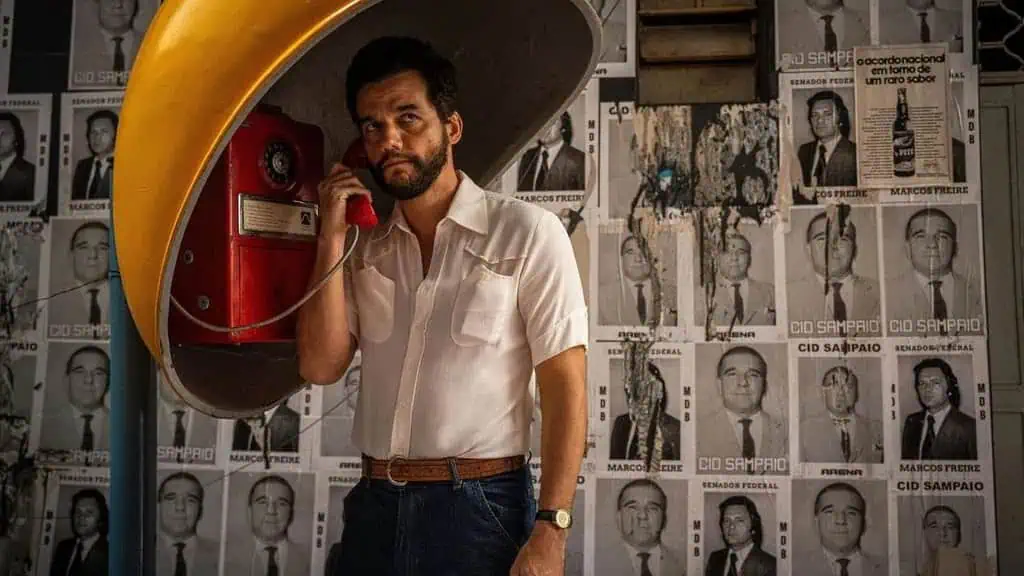
Is he a secret agent? Is he deep undercover in an assumed identity, gathering intel to overthrow the violently corrupt and authoritarian military government? If so, why does he go home to see his son? Why are there two non-chalant hitmen hired to track him down? And why was there a human leg found inside of a shark’s stomach?
Any answers to these questions are kept intriguingly – at times even frustratingly – close to the chest for the whole first half of the film. And with a runtime of two hours and forty minutes, that means you’ll spend the length of some entire movies almost completely lost as to what’s really going on.
That first half moves with much of the energy and momentum that we’ve come to expect from a stylish, complex espionage thriller. There’s fun, slickness, sexuality, and a cracking pop culture soundtrack of 70s hits – both American and Brazilian – that’ll keep you nodding your head even while you’re scratching it.
But beyond that mid-point watershed of revelation, it all takes on a very different tone.
With explanations, flashbacks, unexpected time jumps, and reconsiderations, we’re swept into the harsher realities of Brazil in the 70s, a world where paranoia was the norm, where corruption reigned, and where the rich could silence anyone they wanted with just the signing of a check.
It’s not a stylish spy-thriller world. It’s a true part of history from just a few decades ago, a time when any normal person could find themselves thrust into a life of makeshift espionage overnight.
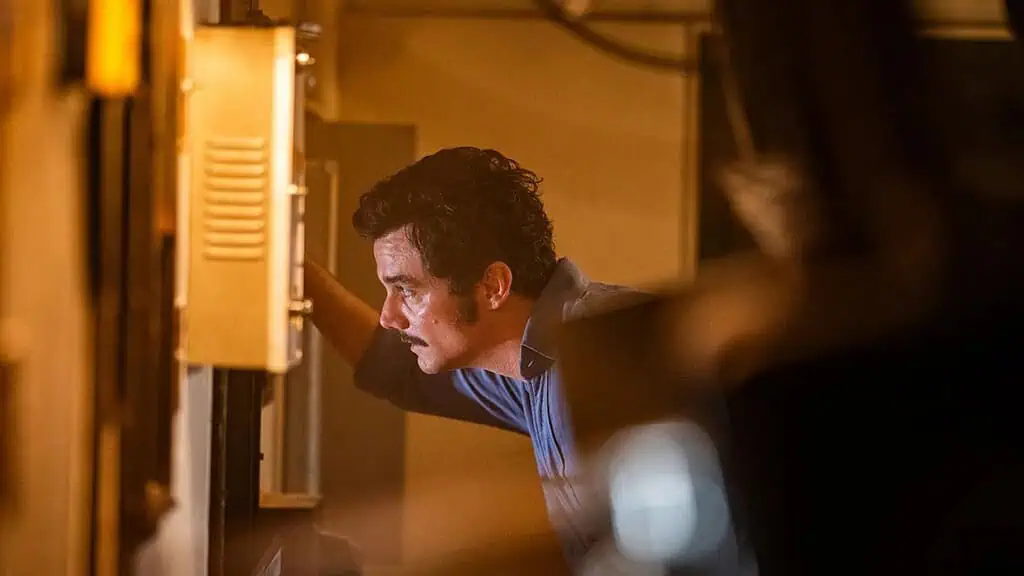
But in Mendonça’s hands, it’s not a blunt historical drama, but an exploration of how authoritarian indifference erases our history as it‘s happening, how our gaps in information create our gaps in understanding, and how we often can only make sense of reality through a filter of pop culture.
Because anyone that uses a fake identity and moves in secret, looking over their shoulder for the operatives of a villainous government must be a secret agent, right?
When human remains are found inside of a shark, it must be from a killer shark attack, just like “Jaws.”
It’s films and music and urban legends and rumors that fit together to form our understanding of the past and our reference of what the world was, even if it was hell at the time.
Spielberg’s shark attack masterpiece and “The Omen” are recurring characters throughout, just like the pop songs on the radio, the iconic 70s cars, and the unmistakable 70s fashion.
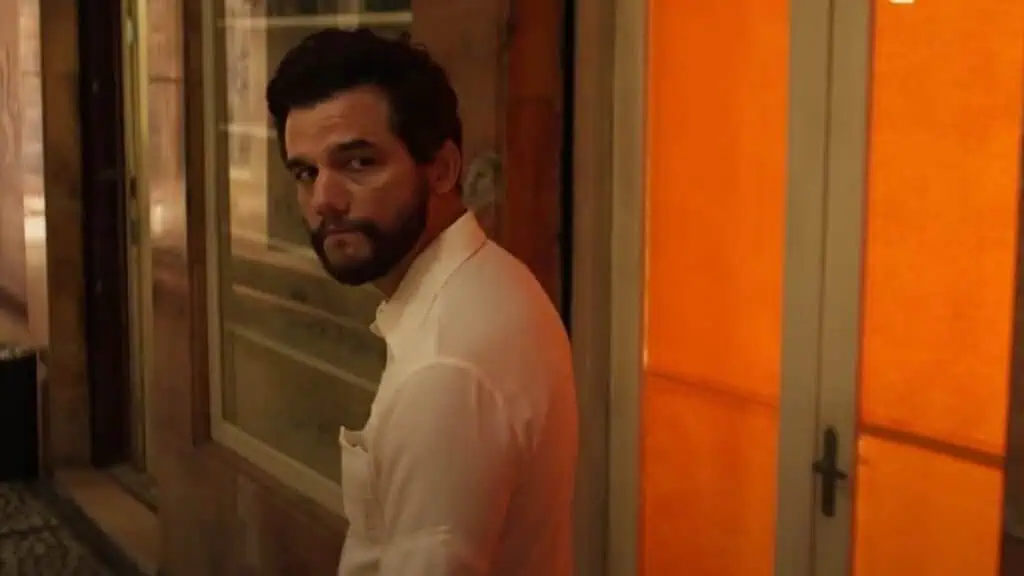
Mendonça uses those cultural checkpoints to ground himself and his own understanding and memory of his real hometown of Recife, just as he did in his 2023 documentary “Pictures of Ghosts,” in which he explored the history and tumult of Recife through his own memories of cinema and city theaters.
In “The Secret Agent,” it’s all filtered, too, through the staggeringly poised and internal performance of Wagner Moura, who picked up the Golden Globe for Best Actor – Drama in a mild upset over bigger American names like Michael B. Jordan and Dwayne Johnson.
But Moura’s performance is undoubtedly deserving, carrying the entire emotional weight and intrigue of the film, even as the ensemble around him is sprawling to the point of confusion, and carrying all the story’s stakes with a worrying and fearful depth, even as you often have no idea what the stakes are.
He might even end up as the only actor this year to give Timothée Chalamet a real run for the Best Actor Oscar (though it looks like Timmy’s turn in “Marty Supreme” is still the easy favorite for now.)

Still, in a year loaded with powerful and phenomenal international features like “It Was Just an Accident,” “The Secret Agent” is feeling more and more like a lock for the Best International Feature award, even being as challenging as it is.
It challenges your comfort with moments of grisly, graphic violence and jarring sexuality. It challenges your understanding and immersion with left-field forays into oddball fantasy (pulled from real Recife legend) of disembodied legs serially kicking people.
And it even challenges our need for easy answers and resolution with an ending that has left some audiences reeling for meaning.
But that’s memory.
We use songs and films and childhood drawings to contextualize the things we want to remember, and we mostly just skip over the things we don’t, even as we all keep looking over our shoulders for the past like a spy trying to outrun his enemies.
“The Secret Agent” screens at the Oklahoma City Museum of Art January 16th through 25th.
For times, tickets, and more, visit okcmoa.com.
Catch Brett Fieldcamp’s film column weekly for information and insights into the world of film in the Oklahoma City metro and Oklahoma. | Brought to you by the Oklahoma City Museum of Art.

Brett Fieldcamp is the owner and Editor in Chief of Oklahoma City Free Press. He has been covering arts, entertainment, news, housing, and culture in Oklahoma for nearly two decades and served as Arts & Entertainment Editor before purchasing the company from founder Brett Dickerson in 2026.
He is also a musician and songwriter and holds a certification as Specialist of Spirits from The Society of Wine Educators.