
OKLAHOMA CITY – With all of the focus on the Best Picture nominees and the biggest, most visible figures and faces in acting contention, it’s easy for the Oscar conversation to get swept away into the star-studded live-action crowd-pleasers and emotional indie underdogs.
But while so much talk has covered the gritty, 70s-style photography of “One Battle After Another” and “The Secret Agent” or the lush, natural tonalities of “Hamnet,” too many audiences are overlooking what might be the most eye-popping and heart-swellingly gorgeous film of the year.
Look to the Best Animated Feature category and you’ll find a currently little-known-in-America jewel of storytelling, color, and the unique adventure of childhood called “Arco” by French animator and first-time feature director, Ugo Bienvenu.

Now in a limited run in just a handful of Oklahoma theaters, with a full engagement coming soon to the Oklahoma City Museum of Art, “Arco” is exactly the kind of curiously underseen, “traditionally” animated standout that feels primed to be tragically overlooked next to its high-tech, higher box office competition.
But it should be seen.
It’s a simple tale on its face, a story of a lost, possibly magical boy and the equally-but-differently lost little girl that finds him in the woods, forming a bond of young friendship that’s tested by turmoil in both of their worlds on the path out of childhood.
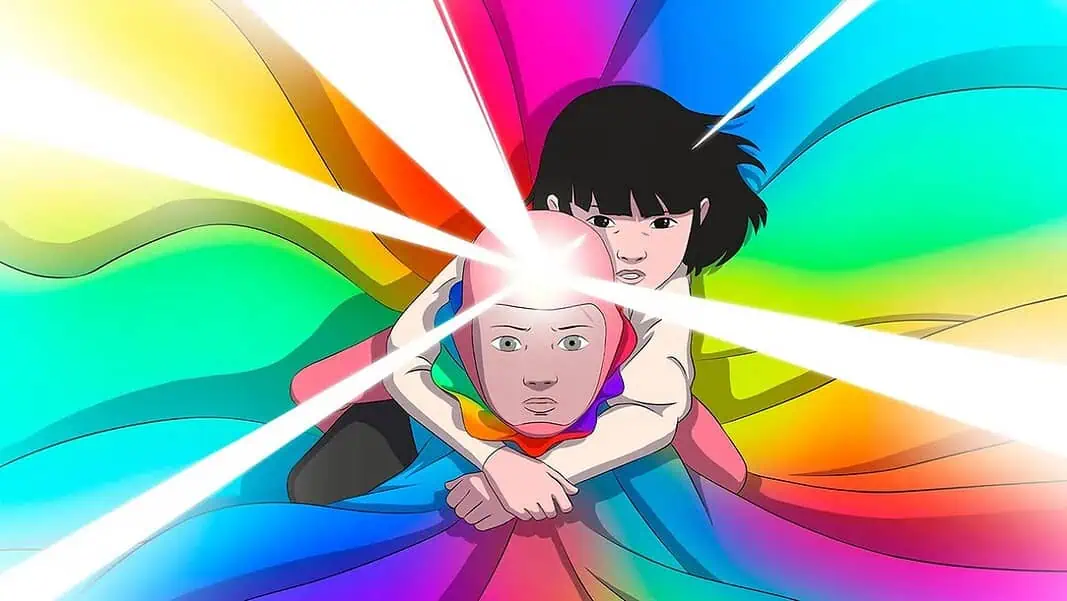
But the sheer creativity, intelligence, and staggering, beautiful color elevate “Arco” to something that feels singular and fresh, even as it offers the familiar comfort of an obviously Ghibli-style film.
See, that magical boy – the titular Arco himself – isn’t magical at all. He’s just a 10 year-old from far in the future, where things like flight and time travel are commonplace and recreational, but reserved for older ages for safety.
So when he sneaks out early one morning to try his hand secretly at a time-hopping solo flight in his sister’s vibrant, rainbow-colored cloak, he gets it all wrong and crash lands in 2075.
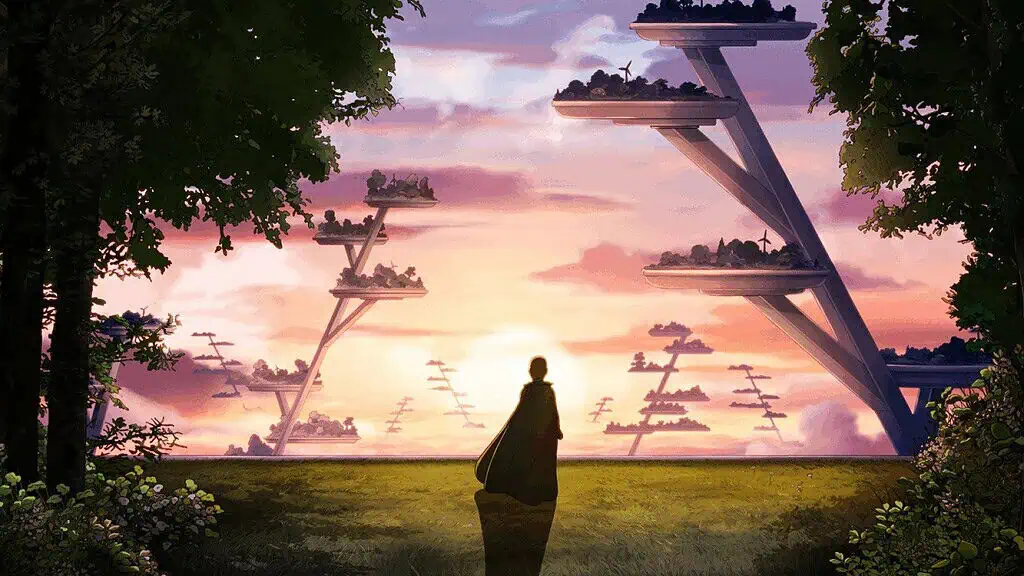
That’s where he meets Iris, a lonely girl being raised in the suburbs by her robot nanny and only talking to her parents in holograms as they’re both too busy to be home. Climate collapse has meant near-constant severe storms and fires and every house is now equipped with an impenetrable bubble to keep the killer elements at bay.
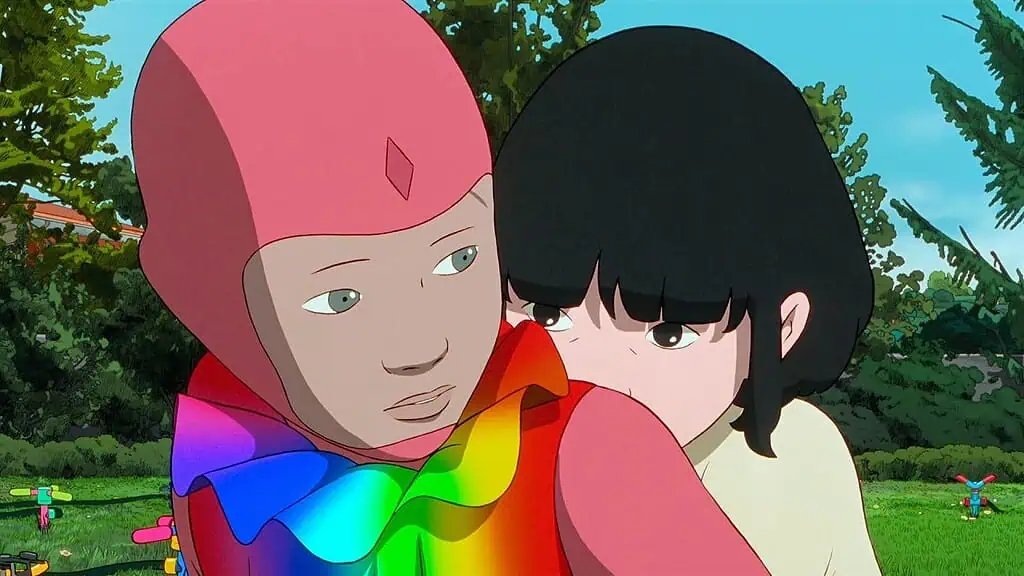
As is so often the case, Iris is Arco’s one chance to find a way back home to his time and Arco is Iris’s one chance to break out of the monotony and isolation of her suburban life, and so their bond becomes stronger as the world closes in on them.
There’s the robot police searching for the mysterious boy that shouldn’t exist, an impending natural catastrophe that could wipe out the town, the school friend that’s harboring his own feelings for Iris, and three hapless, goofy, color-coordinated brothers intent on capturing Arco to learn his secrets.
But while all of that might feel like it’s following the usual beats, there’s just something so effective and powerful about how Bienvenu pulls it off.
It could so easily be just another example of a lonely protagonist being swept away by a compelling, but ultimately flat magical savior ala “Starman” or even “The Shape of Water,” but it’s not. Arco isn’t some fantasy vessel for Iris to project her wildest dreams into. He’s just a kid, just as lost and confused and just as prone to mistakes and emotion.
Iris and Arco don’t have that kind of wry precociousness or camera-winking comedy we’ve come to expect from Disney and Pixar. They’re just kids, and the film isn’t trying to be a “comedic adventure.” It’s just an adventure.
And that’s not only why their bond feels real and feels heavy, but also why the story works so well as a genuine exploration of childhood friendship and the doors into adolescence. They both learn from one another and they both lean on one another, and when the stakes begin to build and spiral toward a seriously exhilarating and dense climactic act, you care in a way that’s tough to pull off in this Marvel era of constant cataclysm.
All of which is why the story feels so effectively emotional and why the script feels practically airtight.
But the reason “Arco” demands to be seen – and seen big – is the absolutely stunning color and animation.
Blending the sweeping background worlds of Miyazaki with a kind of minimalist, 70s-era rotoscoped character design recalling Bakshi’s “Lord of the Rings,” Bienvenu presents his sci-fi odyssey of unexpected friendship in the vein of traditional 2D animation (though there’s clearly a lot of hypermodern, 3D accompaniment.)
This is decidedly not anime (and there’s been some frustratingly negative sentiment floating around clearly coming from anime purists that don’t understand an animated film that isn’t copping Japanese character design,) but it is a modern take on European animation by way of the Japanese masters.
There’s no denying the Ghibli influence, but it still feels wholly western, and with an English voice cast featuring Natalie Portman, Mark Ruffalo, Will Ferrell, Andy Samburg, and Flea, you’ll find it tough to believe that it was originally recorded in French.
“Arco” is, simply, a genuinely moving and gorgeously, vividly visual experience, and surely ranks among my favorite films of the year.
But will it win?
That’s tough to say.
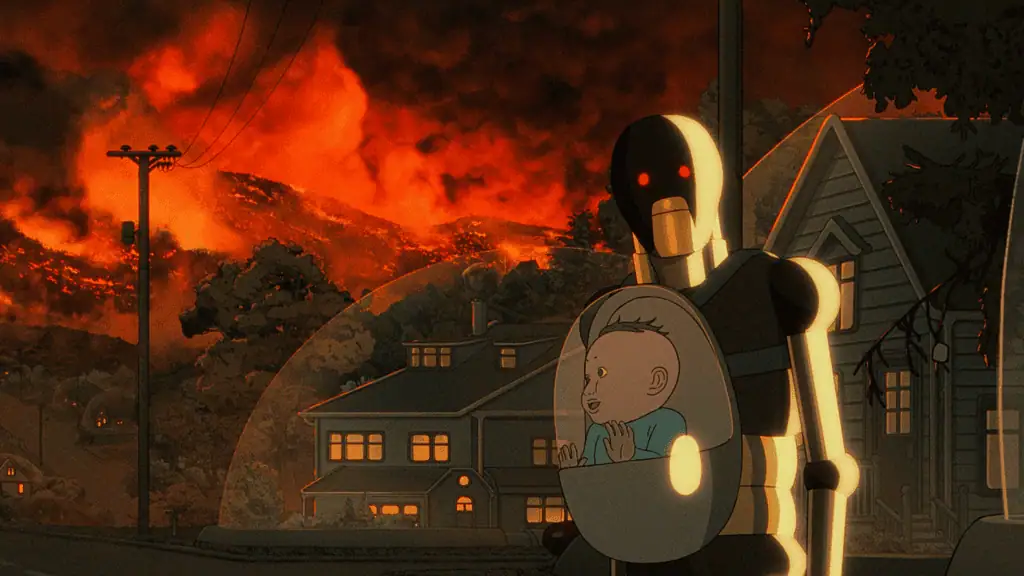
The Best Animated Feature category can be a toss-up, but as more and more 3D animated films win it, more and more 3D animators become Academy voters, which can mean more modern art styles and animation designs reigning. And that’s not even accounting for the towering box office, streaming numbers, and pop-cultural penetration of presumed frontrunner “KPop Demon Hunters.”
Could a little underseen gem of traditional-style French animation and earnest childhood friendship really triumph over one of the biggest and most ubiquitous pop culture properties of the year?
On its own merits, yes. But we’ll just have to wait and see how the Academy votes.
“Arco” is showing in limited engagements in Oklahoma theaters now and is coming soon to the Oklahoma City Museum of Art.
Catch Brett Fieldcamp’s film column weekly for information and insights into the world of film in the Oklahoma City metro and Oklahoma. | Brought to you by the Oklahoma City Museum of Art.

Brett Fieldcamp is the owner and Editor in Chief of Oklahoma City Free Press. He has been covering arts, entertainment, news, housing, and culture in Oklahoma for nearly two decades and served as Arts & Entertainment Editor before purchasing the company from founder Brett Dickerson in 2026.
He is also a musician and songwriter and holds a certification as Specialist of Spirits from The Society of Wine Educators.