OKLAHOMA CITY – On a Wednesday night in the heart of Film Row in downtown Oklahoma City, guests settled into their seats at the Oklahoma Film Exchange with popcorn and soda in hand.
As the lights dimmed, the room fell quiet at this sold-out event that captured a rare convergence: a screening of an Oscar-nominated film just weeks before the Academy Awards and a conversation about Black history and the Jim Crow South, all inside a screening room that had recently faced possible closure.
In the weeks leading up to the Feb. 18 event, local film fans refreshed their inboxes to check their waitlist spots, hoping to get in. By screening night, the 50-seat room, housed in the historic Paramount building on Sheridan Avenue, was full for a showing of “Sinners,” Ryan Coogler’s genre-blending vampire drama.
The film follows two Black twin brothers navigating life in 1930s Mississippi alongside supernatural threats, and explores the power of blues music as well as the need for community spaces.
With the Academy Awards approaching on March 15, anticipation carried extra weight. The film is nominated for 16 Oscars, including Best Picture, breaking the Academy’s record for most nominations in history.
Hosted in partnership with the Jeanne Hoffman Smith Center for Film and Literature at Oklahoma City University, the screening included a post-film conversation with University of Oklahoma historian Karlos Hill, who served as a consultant on the film, moderated by Oklahoma City Councilperson and OCU faculty member James Cooper.
Black History and the blues
Hill, a Regents’ Associate Professor of African and African American Studies at the University of Oklahoma and a nationally recognized scholar of racial violence and historical memory, advised the filmmakers early in development, with the first consulting calls beginning in 2023.
“It was deeply an honor and a privilege to be able to have conversations with Ryan [Coogler] about the film very early on in the film’s creation,” Hill said at the screening.
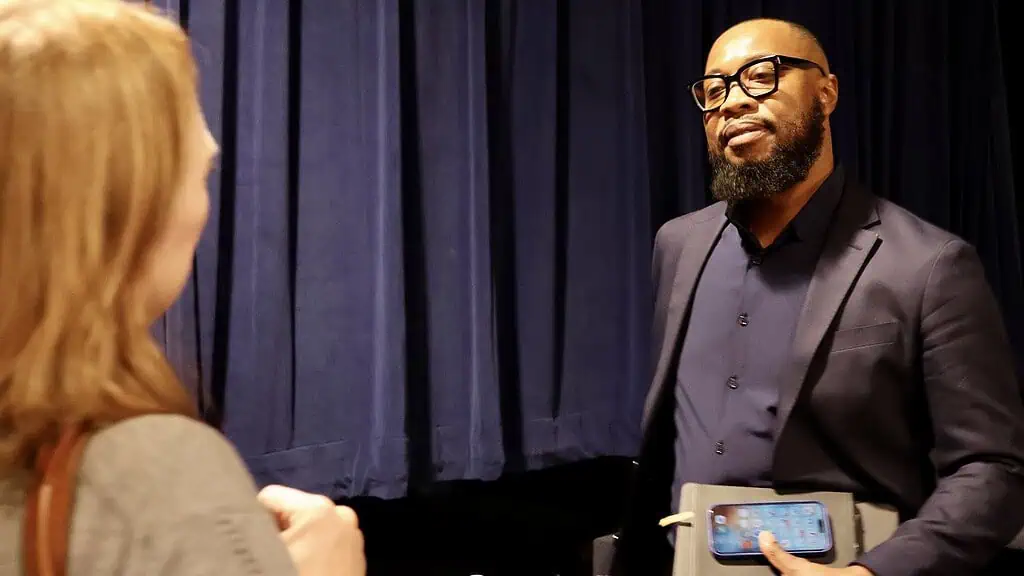
He explained that his role involved grounding the story in the economic and social realities of Depression-era Black life in the South.
Throughout the discussion, Hill repeatedly returned to one central theme, which appears frequently in the film itself: blues music. One of the subjects that Hill discussed with Coogler was the story of celebrated blues singer, Robert Johnson, whose influence was apparent in the young blues singer character of Sammie in the film.
“Blues music plays a central role in the film, but it’s also the central tension in the film,” he said.
Coogler contacted Hill not only for his expertise on Johnson, but also for his knowledge of the Mississippi Delta.
“I have a really emotional response to watching the film, because of what I know about the Jim Crow South,” Hill said.
In the movie, the juke joint functions as one of the few spaces where Black characters can experience freedom amid the constraints of Jim Crow. Hill described blues as emerging from the “sorrow songs of enslaved people,” carrying not just grief but also humor, resilience, and hope.
“Music can be healing,” he said. “Music can be liberatory and transformative.”
Resisting revisionism
The conversation also explored how the film challenges the idea that the North offered automatic freedom during the Great Migration. Chicago, Hill noted, is portrayed not as salvation but as “Mississippi with tall buildings,” where racism and exploitation persist in different forms.
That tension, the dream of freedom and the repeated denial of it, became a focal point of the discussion. Hill described the film as confronting what he called the “impossibility of Black life in the Jim Crow South,” where even moments of progress are threatened by both worldly and supernatural forces.
He added that he experienced the movie “not as a horror film but as one that helps me to think and feel a deep belonging.”
Cooper, alongside Hill in conversation, framed the film as part of a longer tradition of genre storytelling.
He described a moment in the film where he felt seen “in a way I rarely do” and discussed various interpretations of the film and its use of vampiric folklore or its usage of (or avoidance of) certain horror tropes. Cooper and Hill answered several questions from attendees, exploring these topics and others further.

Hill noted it was only his second time speaking in front of an audience about the film and, more notably, his first time watching the film with a public audience.
“It’s really amazing to see and hear your responses and reactions in real time,” Hill told the audience.
Local impact
The evening also highlighted the growing role of Oklahoma Film Exchange in the city’s cultural landscape.
Opened in September 2025, The Oklahoma Film Exchange (OFX, as the owners call it) operates as a cooperative microcinema focused on programming, community discussion, and preservation of Film Row history. The venue seats about 50 people and typically uses a pay-what-you-can model, operating with fiscal sponsorship support from the Oklahoma Visual Arts Coalition.
“We’re kind of just doing what we’re missing in the city,” said River Lunsford of OFX. “Repertory screenings of films you can’t see anywhere else. We’re doing whatever keeps people from sitting at home and watching them alone.”
Lunsford emphasized the importance of intimate space in fostering conversation.
“The space is very limited, which makes it really intimate and able to be close with people in your community,” Lunsford told Free Press. “Being able to cultivate that environment where people feel safe to share those thoughts is incredibly valuable.”
The message resonated with the packed audience for “Sinners.” Some attendees even took out their phones before the screening to pledge financial support.

Lunsford said the OFX team was excited when Oklahoma City University approached them about hosting the event.
“The history of this film and the fact that it takes so much care into its historical details is so enriching and interesting, and I can’t think of anything better than getting to host the historian who literally made the film happen,” Lunsford said.
With “Sinners” leading this year’s Oscar nominations, the sold-out event showed how a global film conversation can take root locally. Inside the historic Oklahoma Film Exchange building, the contemporary Black history–centered film sparked discussion among local historians and film leaders in the heart of Film Row.
For those who stayed through the end credits, they may have noticed a special thanks to a familiar name: Dr. Karlos Hill.

Zoe Elrod covers events and happenings around Oklahoma City for Free Press bringing her skill as a reporter and photographer. Zoe has spent her career covering local musicians, artists, politicians, and everyday folks.