
OKLAHOMA CITY – Witch hunts, accusations, courtroom drama, and political theater.
It could all just as easily be coming from the cable news and talking heads of the 21st century or from the stump speeches and social media accounts of our most divisive and antagonistic political figures.
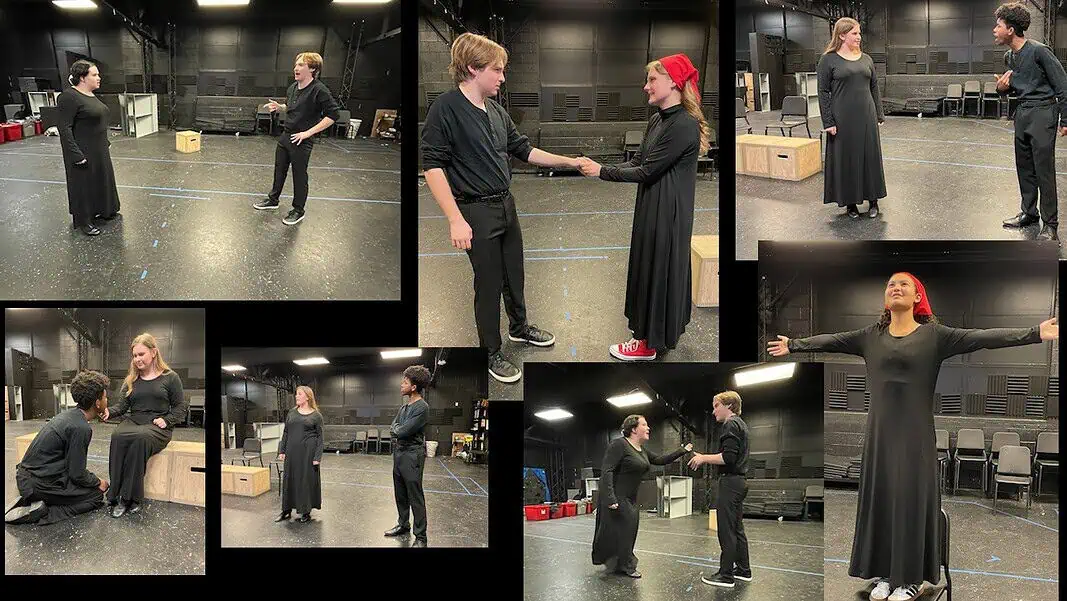
But for three days in Oklahoma City, it’ll be coming from the stage and from the teen actors focusing all of their own anger, confusion, and turmoil through the words of legend Arthur Miller and his fiery, dangerous, and sadly always relevant masterwork, “The Crucible.”
The Classen School of Advanced Studies (SAS) High School is presenting the landmark play in their auditorium Thursday, February 26th through Saturday, February 28th with two separate student casts, each approaching the fraught, politically charged text with their own electricity and their own lived experience.
“’The Crucible’ has never not been a political story, it was written to be political,” Classen SAS senior Magnolia Anderson told Free Press during a behind-the-scenes visit coordinated and supervised by school staff.
Miller’s 1690s-set play, dramatizing the religious furor and the ultimately deadly church-driven mob justice of the Salem Witch Trials, was first written and performed during the 1950s height of McCarthyism and the similarly accusatory and anti-factual “Red Scare.”
Even at the time, it was a controversial story, and it’s only seen that reputation continue since, regularly turning up on lists of banned texts and outrage-inducing performances for decades.
“It was written to mirror what was happening in the world at the time,” said Anderson, who is playing the part of wrongfully accused Elizabeth Proctor in one of the alternating casts, as well as serving as costume designer. “But by taking into account everything, we can really see lies affecting people in our world now and how sacrificing ourselves for the truth can affect the world now. By making those connections, it really enforces the story.”
The students say they’ve been encouraged to draw those parallels– from the lies and accusations of the 1600s to the trials and blacklistings of the 50s and 60s up to the disinformation and political vilification of the modern world – in order to understand the weight and continued relevance of Miller’s story.
The minimal staging and stark, non-period costuming were also designed to free the story from any specific timeframe, as was the casting by Classen SAS drama instructor Lauren Peck-Weisenfels.
“While this show was cast by Ms. Peck to be racially blind,” said Myles Currin-Moore, one of the students in the lead role of John Proctor, “it’s still important to consider that, in our production of it, I am a Black man. This is someone who is being tried and persecuted for something that he didn’t do, and is, primarily by coincidence, being judged by white men. And it’s up to me as an actor whether or not I want to lean into that and make that a part of the story.”
Each of the cast members is bringing their own spin to their role and infusing their portrayal with their own complicated feelings, and even condemnations, of the characters, unsurprisingly informed by the very real dramas of the wider world that they’ll soon be graduating into.
“I feel like for any kind of performance, you’ve got to always bring your own little something to it,” said Miles Bowman, who is also playing John Proctor. “John Proctor does not do good things. He’s a very flawed man, but that’s not me. I got to speak to [stage actor] Marc Kudisch, and he basically told me ‘it’s not your job to apologize for this character. It’s your job to portray them.’”
But that can be a tough tightrope to walk when your character is responsible for such heinous actions and such deadly outcomes, a complexity that the performers for the role of volatile, finger-pointing Abigail have had to parse for themselves.
“In my opinion, she has this complex of seeing her parents die and then having these things happen that keep giving her a sense of power,” said Elle Earley, one of the performers tackling the Abigail role. “But she’s also a young girl in this situation with this power, but not knowing how to grasp it.”

It’s an almost ironic twist to see these students thinking so deeply and considerately about the naivety of youth and the inability of these young characters to understand their power when the same accusation is being leveled at students their age right now.
Amid student walkouts, youth-led protests, and young adult political movements, teenagers have been recently barraged with claims that they’re too young to understand what it is that they’re protesting or too naïve to know if they’re being manipulated.
The cast members in this “Crucible” beg to differ.
“For people to say that we’re too young to talk about these topics, it’s like they don’t realize that we’re about to be voting age,” said Amani Boulos, who is also playing Abigail in the production. “We should be able to learn about these things and prepare ourselves, and I feel like what’s really pivotal about doing a stage play is people can truly see it, rather that it just being another assignment.”
That’s why the students on stage are pouring so much of their fire and youthful energy into their performances, but also why their teachers have so openly encouraged them to connect with the complexities and the sometimes still-controversial undertones of the play.
“We’re Classen School of Advanced Studies, so we ask our students to think in an advanced way about everything,” Ms. Peck told Free Press. “But for me, as a theater teacher, art is about encouraging students to find who they are and what they think, rather than me telling them how to think and feel.”
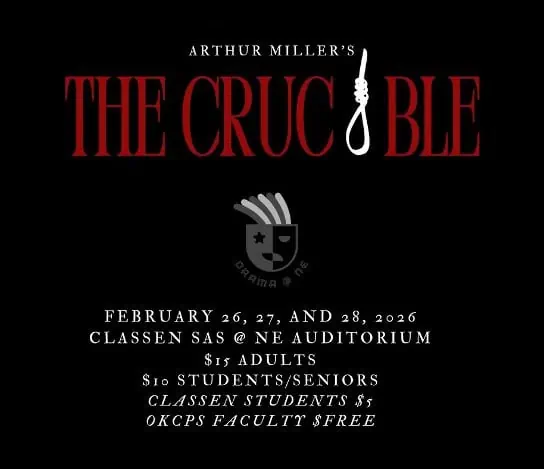
Classen SAS at Northeast presents Arthur Miller’s “The Crucible” Thursday, February 26th through Saturday, February 28th.
CLICK HERE for times, tickets, and more information.

Brett Fieldcamp is the owner and Editor in Chief of Oklahoma City Free Press. He has been covering arts, entertainment, news, housing, and culture in Oklahoma for nearly two decades and served as Arts & Entertainment Editor before purchasing the company from founder Brett Dickerson in 2026.
He is also a musician and songwriter and holds a certification as Specialist of Spirits from The Society of Wine Educators.