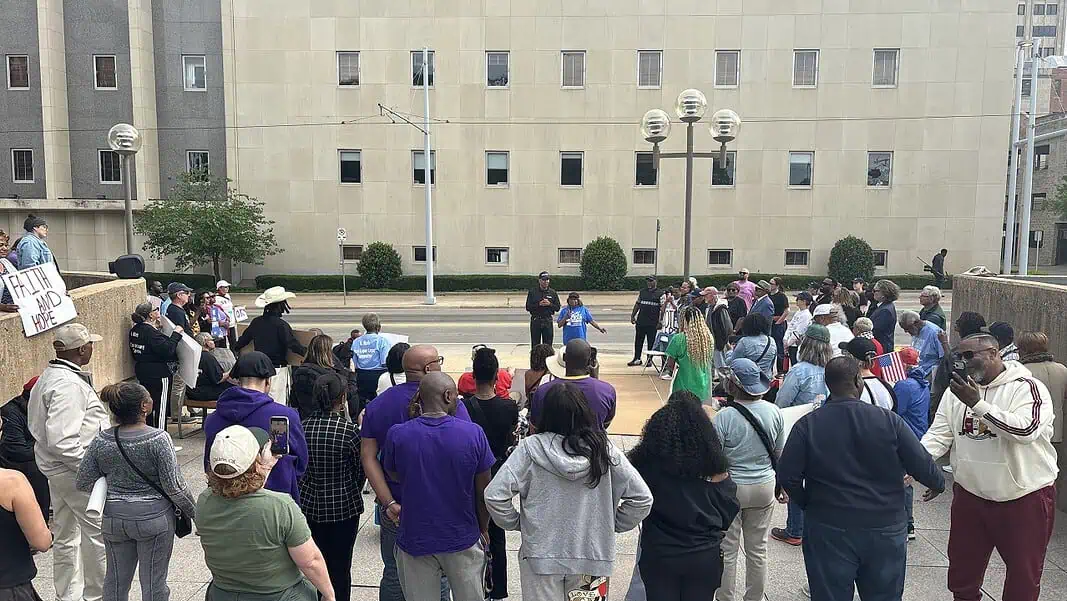

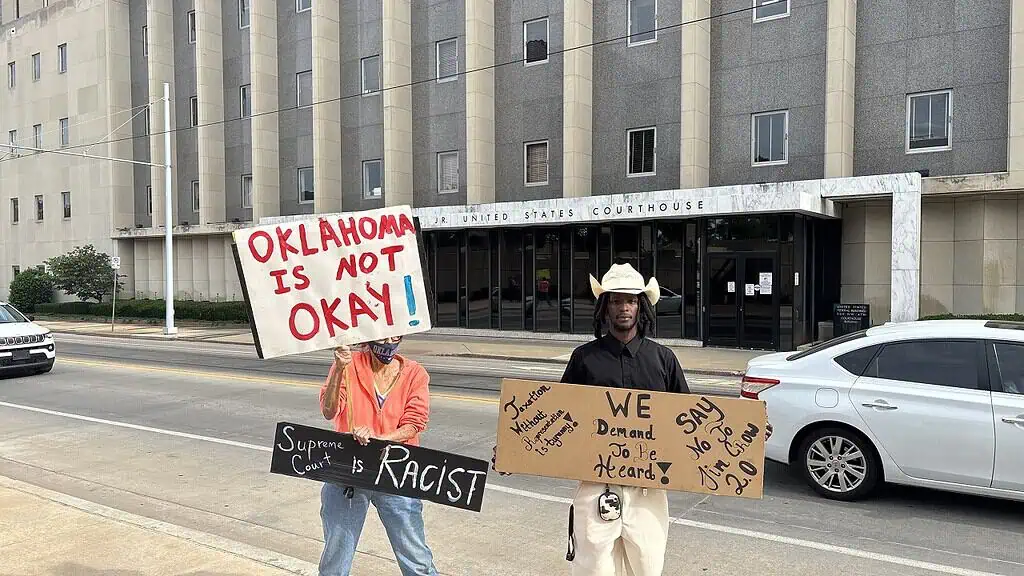
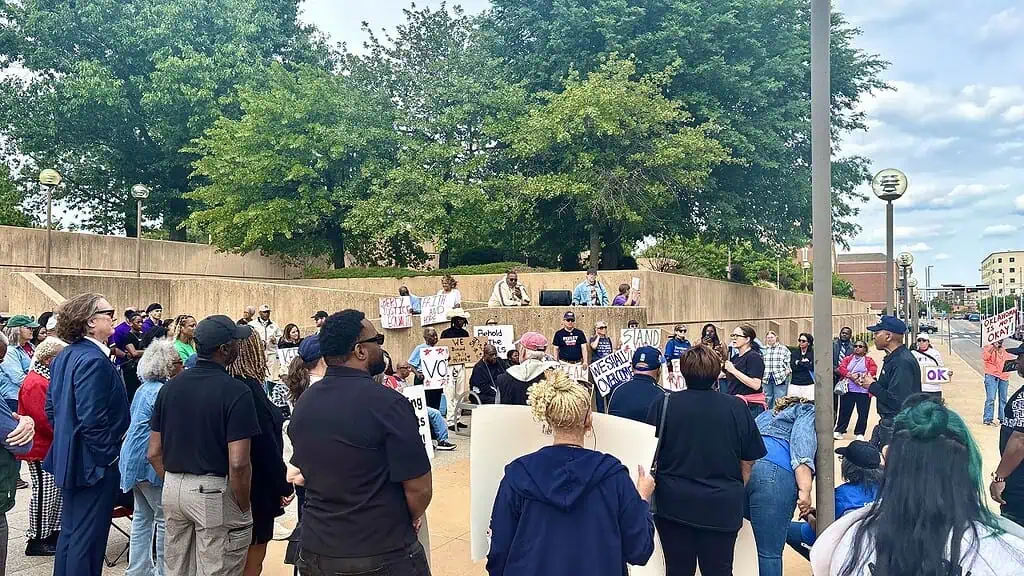
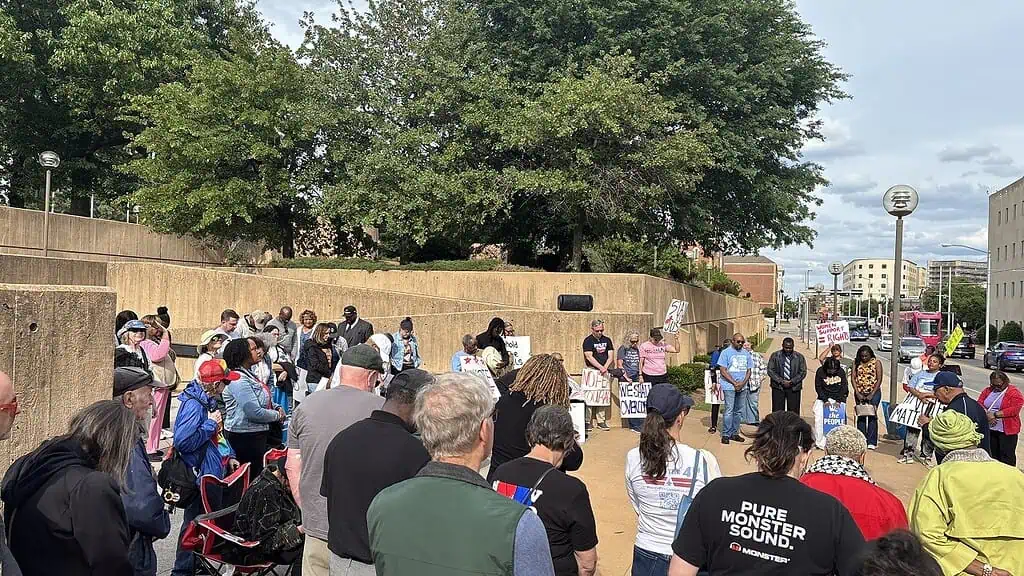
OKLAHOMA CITY – Activists and Civil Rights leaders joined state legislators outside the federal courthouse in downtown OKC Friday to protest against the US Supreme Court’s decision overturning a key element of the Voting Rights Act.
Leaders of the ACLU of Oklahoma, the NAACP’s OKC chapter, and the Clara Luper Legacy Committee gathered with government officials and candidates to voice disappointment and palpable anger over the Supreme Court’s decision in the case of Louisiana v. Callais.
In a 6-3 decision Wednesday, the Court ruled that Louisiana’s congressional district map was unconstitutional because it had been drawn to help ensure that Black voters in the state had representation in Congress roughly proportional to their population.
Civil Rights leaders say the ruling substantially weakens the Voting Rights Act of 1965 and threatens to dramatically reduce the voting power of minorities in predominantly white and conservative states.
Though the short-notice rally Friday boasted only a modest crowd of a few dozen, leaders used the protest as an opportunity to encourage vigorous voter registration efforts and greater turnout across Oklahoma in this year’s Midterms.
“So many times yesterday, we heard ‘this isn’t really going to impact Oklahoma,’” ACLU of Oklahoma executive director Tamya Cox-Touré told the crowd, “but any time a vote is erased in this country, it impacts us all.”
Concerns at the state level
The Supreme Court’s decision has sent Voting Rights activists and organizers nationwide into a panic at the possibility of maps being rapidly redrawn to break up districts originally created to ensure minority representation.
“I want you to know that this will affect Oklahoma,” State Senate Minority Leader Julia Kirt told the gathering outside the federal courthouse Friday. “I sat in the room where they drew the maps last cycle. I sat in that room and they honored the Black districts only because of the Voting Rights Act.”
The country currently has nearly 150 “majority-minority districts” – congressional districts in which racial minorities outnumber white voters – with nearly half of those districts potentially threatened by the ruling, particularly in Florida and Alabama, where Republican legislatures are already taking steps to redraw state maps.
While Oklahoma doesn’t have any majority-minority districts at the federal congressional level, the Oklahoma State Legislature does include districts only recently created to comply with the Voting Rights Act by ensuring minority representation.
Speaking to Free Press following the protest, Sen. Kirt said those state-level seats are the ones she’s most worried about.
“The State House and State Senate maps are where it’s most dangerous for minority representation,” Kirt told Free Press. “We have very few Black seats, and this last cycle is the first time we’ve had firmly Latino seats. Senator Brooks-Jimenez in District 44, for example, and some of the House seats got very much established as Hispanic voter seats, right? So does that now go away when we just started having that distinct power to make sure that those communities could vote together and have that united voice?”
Ready for a fight
While some, like Sen. Kirt, said that the Supreme Court ruling came as an unexpected shock, others leading the protest Friday said that they’ve been preparing for such a development for some time.
“We’ve been recognizing that there’s been a concerted effort – a coordinated effort – to do away with some of these rights,” Cox-Touré told Free Press. “We knew the Voting Rights Act was always at risk, as well as Civil Rights Act, and our job, we feel, has been to protect that and to do what we can.”
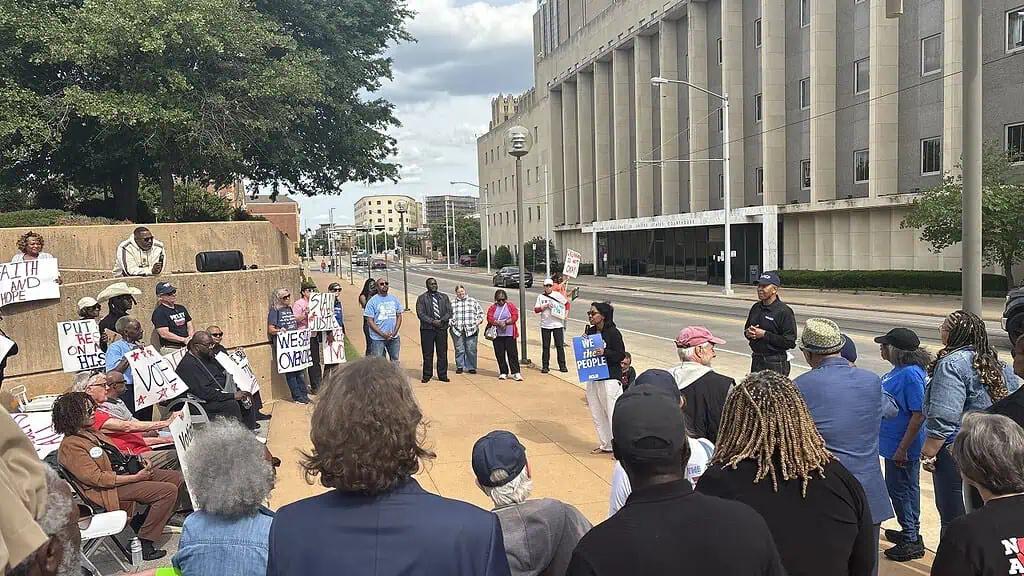
Like Kirt, Cox-Touré expects Oklahoma’s fight to play out at the state and local levels, and she said that the ALCU of Oklahoma has already prepared lawyers and litigation to push back against any efforts to rapidly redraw district maps.
“We know in Oklahoma is that our fights continue to be at the local level,” she said. “For us, the fight’s always been here, regardless of what’s happening at the national level.”
‘This fight is just re-starting’
Leading the protest Friday was Marilyn Luper Hildreth, a lifelong activist and daughter of Clara Luper, one of Oklahoma’s most prominent and influential organizers during the Civil Rights Movement of the 1950s and 60s.
“There’s something happened in America. We have more hatred now than I felt during the Movement.”
-Marilyn Luper Hildreth
As a child, Hildreth joined her mother in high-profile sit-ins and protest actions in Oklahoma that helped build support for landmark Civil Rights legislation like the Voting Rights Act itself, often enduring open violence and physical attacks.
But she still believes that the fight to protect those rights now might be even more difficult than the fight to secure them decades ago.
“After 61 years, I thought we were over that phase,” Hildreth told Free Press following the protest. “There’s something happened in America. We have more hatred now than I felt during the Movement.”
She doesn’t expect that putting pressure on the nation’s current officials will have the same effect that it did in the first Civil Rights era, and she’s instead encouraging the public to voice more vocal public support and sustained pushback to vote them out of office.
“This fight is just re-starting,” Hildreth said, “and the only way we’re going to end this thing is that good people in America who’ve remained silent are going to have to stand up and open their mouths and say ‘this is wrong.’”

Brett Fieldcamp is the owner and Editor in Chief of Oklahoma City Free Press. He has been covering arts, entertainment, news, housing, and culture in Oklahoma for nearly two decades and served as Arts & Entertainment Editor before purchasing the company from founder Brett Dickerson in 2026.
He is also a musician and songwriter and holds a certification as Specialist of Spirits from The Society of Wine Educators.