OKLAHOMA CITY – The Oklahoma Contemporary Arts Center has unveiled a groundbreaking interactive arts exhibit like no other in OKC, not only inviting guests to step into the light and become a part of the experience themselves, but also shining focus onto a major transatlantic collaboration for the city.
With “Anthony McCall: Solid Light,” Contemporary has partnered with London’s renowned Tate Modern, one of the highest-profile contemporary art museums and exhibitors in the world, to bring the shockingly unique and simplistically powerful “light sculpture” works of the British-born, New York-based McCall right here to OKC.
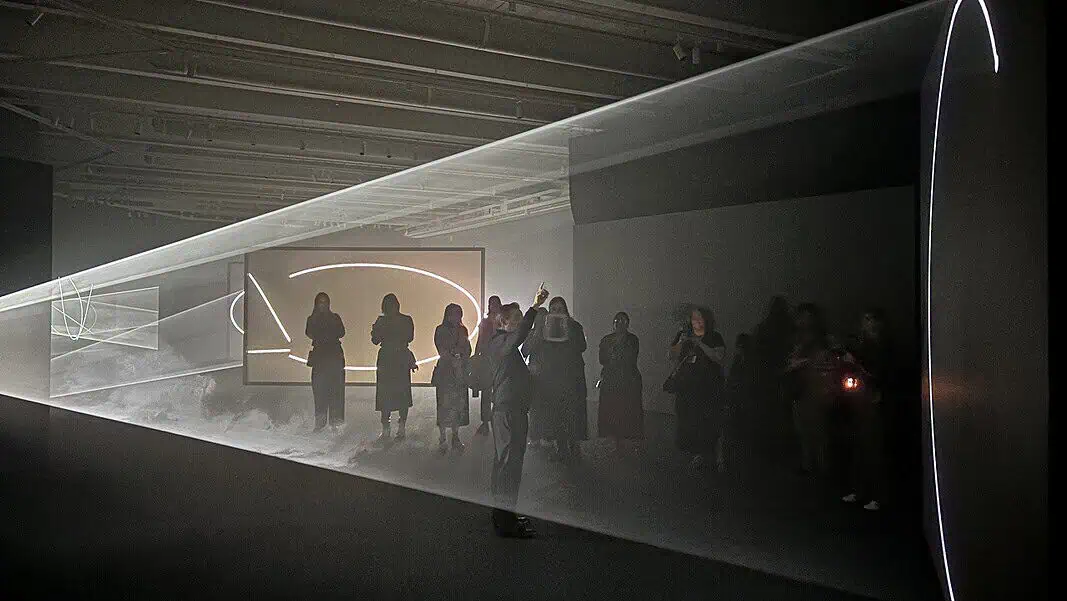
Utilizing a disorientingly darkened space, a haze machine, a handful of projectors, a number of hyper-minimal line animations, and, crucially, the empty spaces between the projector lenses and their screens, Contemporary and the Tate have created an immersive and otherworldly opportunity for guests to step inside the works themselves.
“It is an amazing thing that we were able to achieve,” said Gregor Muir, the Tate’s Director of Collection, during a media preview March 12th.
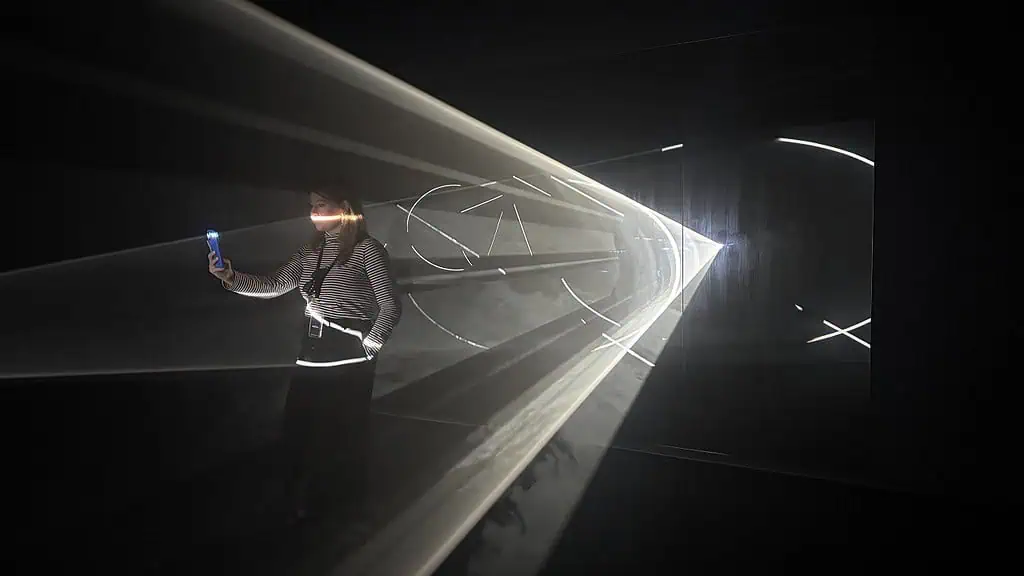
The show presents five of McCall’s “solid light” works, in which projectors display short films of simple, white lines, curves, or geometric shapes onto carefully positioned freestanding screens, with a palpable, omnipresent haze illuminating and defining the path of the light itself, creating visible cones and “sculptures” of light that slowly, repeatedly form themselves before you.
It’s a hypnotic and compelling visual process to behold, but the works become truly immersive and powerful when you step into the projection’s path and become surrounded by the mass-less sculptural forms, the haze swirling around you like thick clouds or ocean fog.
“There is a kind of user manual for these,” Muir said. “It’s always interesting to see a lot of people come and just spend a long time looking at the line projected. You sort of occasionally have to encourage people to turn around and look into the light.”
It might be most visitors’ instinct to stand away and regard the sculptural forms of the projections from afar, but Muir wants everyone to know that the real magic of McCall’s works becomes clear when you step in and let the light engulf you.
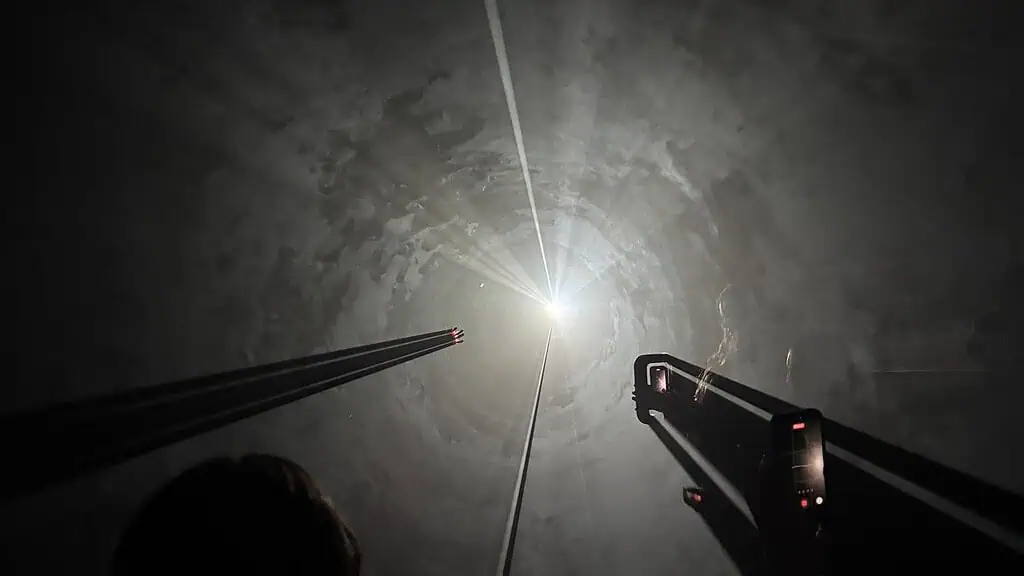
“There is a moment where I think something really primordial stops us from sort of going in, because we almost see the light as a solid barrier,” he said. “But when you do, I think you get that extraordinary effect of the mist making the light thick. It’s incredibly interesting to observe people as they go across the threshold, and that begins to describe, in a way, their presence in with the work and the fact that they’re becoming sort of free themselves to explore it.”
That freedom of exploration and space is even more pronounced at Contemporary than in many other spaces where McCall’s solid light pieces have been projected, owing to the large, open gallery of the arts center’s second floor, allowing for five of the works to be installed together in an almost overlapping, fully immersive environment.
“We’re so pleased that the work has come here,” Muir said. “I shouldn’t say that it’s better than at Tate, but the architecture here is just perfect for these works. We were just thrilled when we walked in and could see all of them, and the way they line up is really exquisite.”
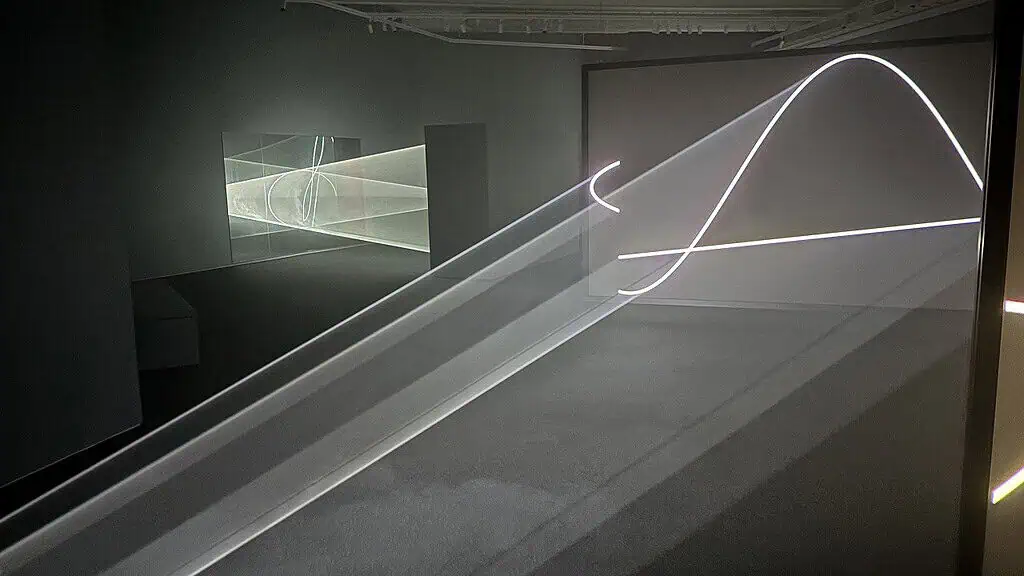
Of course, incorporating that many works grouped together in such a dark and disorienting space meant careful, delicate planning on the part of the Contemporary team. They had to determine just the right amount of darkness, the perfect distance between each of the projections, and the right number of staff to closely watch and guide guests through the experience.
“This was very much an engineering project as well,” Contemporary’s Executive Director Trent Riley told Free Press during the media preview. “Of course the most careful part is when you first walk in, because it’s so dark. But then you can tell that your eyes adjust fairly well the longer that you’re inside and you get used to it.”
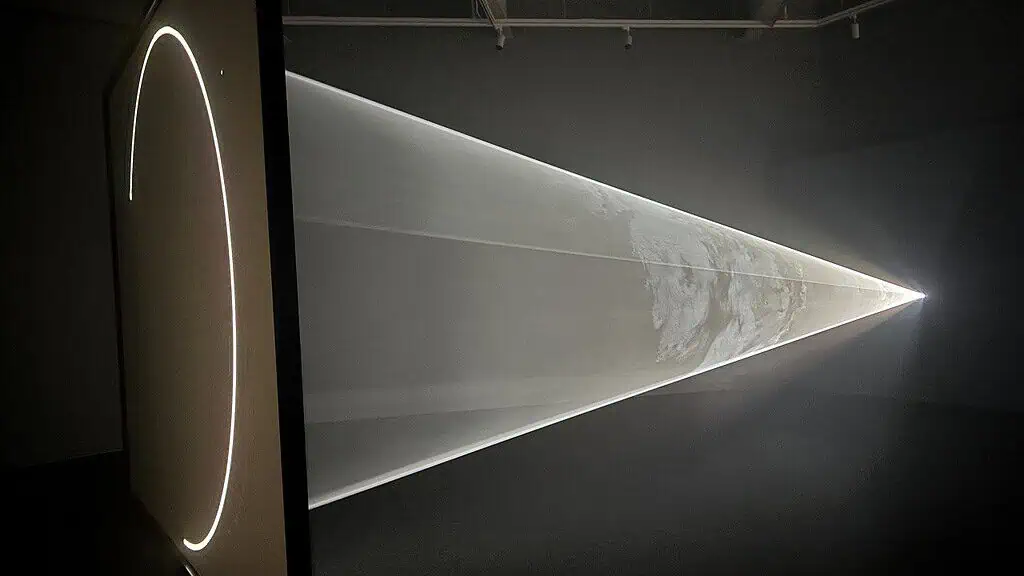
The “Solid Light” series began when McCall unveiled the very first projected work, “Line Describing a Cone,” in 1973, and that’s the first video – and first enveloping, visible light sculpture – that visitors will encounter when stepping into the main gallery space.
The four other projected light artworks span early the full length of McCall’s artistic career, from the 70s to the show’s most recent work from 2018.
But guests will also get a brief look at some of McCall’s earliest work exploring the intersections of light, space, and time with an early video project featuring him and his friends setting fires in an open field.
It’s a striking way to show the development and adventurousness of this remarkable artistic mind throughout the years, with recognition and appreciation for the depth and creativity of McCall’s works blooming again and again over time.
McCall himself – now nearly 80 years old – even got to visit OKC and see this full exhibition in person before the public opening, and Muir said that it was as powerful as ever to see his excitement over the interest in his works.
“I always think he’s got a bit of a glint in his eye,” Muir said of McCall, “because it’s an idea he had many, many years ago in 1973, and it worked, and it’s still bringing him around.”

Brett Fieldcamp is the owner and Editor in Chief of Oklahoma City Free Press. He has been covering arts, entertainment, news, housing, and culture in Oklahoma for nearly two decades and served as Arts & Entertainment Editor before purchasing the company from founder Brett Dickerson in 2026.
He is also a musician and songwriter and holds a certification as Specialist of Spirits from The Society of Wine Educators.