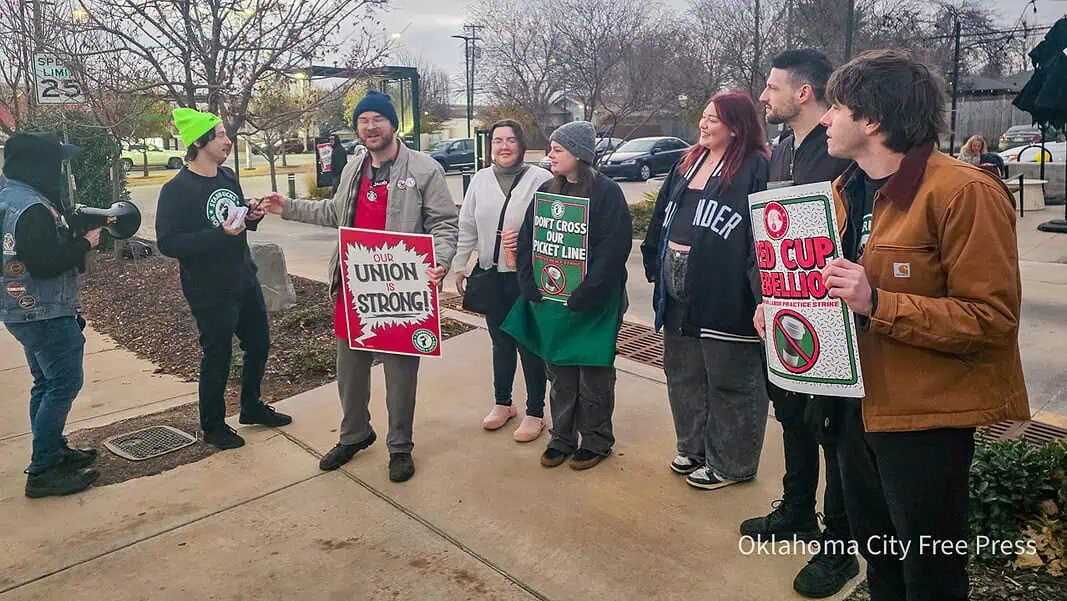

OKLAHOMA CITY – Workers and members of the community gathered at 23rd and Robinson Starbucks and shut the store down in protest of the company’s unfair labor practices, union-busting, and to put pressure on Starbucks to bargain in good-faith for a contract.
This comes after informational pickets were held on Saturday.
Over a dozen people came out Monday morning, with the help of a strike kitchen that helped feed the strikers, and donations to get them through the lost hours.
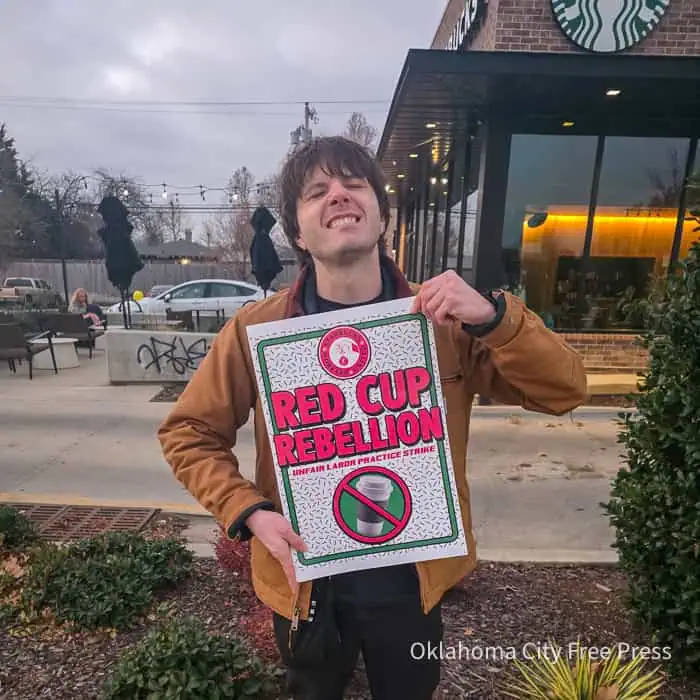
The local action joins the Starbucks Workers United nationwide “Red Cup Rebellion” strike that is underway.
Free Press spoke to several people at the rally to get their perspective.
Strike kitchen
“I’m here representing St. Bénézet Catholic Worker Community of Oklahoma City,” said Zakk Flash. “Father Lance Schmitz are running a strike kitchen out of the Church of the Redeemer.”
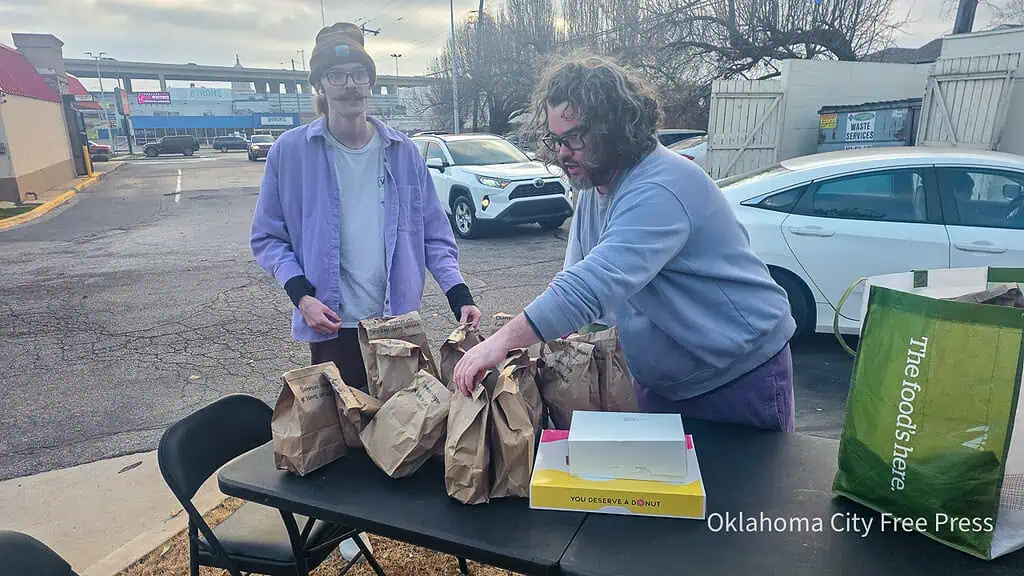
“Nobody should go hungry while they’re fighting for the right thing, so I’m here to support the picket line as a third generation union member, as a second generation Teamster, and as a father in this community who believes these workers get a whole lot more than what they’re getting,” Flash continued. “We have food parcels being put together for striking workers and their families, and we will stand with them as long as it takes for them to get the contract they deserve.”
‘Unfair labor practices’
Dylan Mcentire, barista at 23rd and Robinson, shared his thoughts as well. Asked why he was striking today, he said unfair wages, unfair labor practices and union busting.
As far as some of the struggles of protesting, Mcentire explained, “Some of our baristas are afraid they won’t be able to make their money, but we do have strike fund organizations and support from the community and everything, so we will get paid, as well as donations.”
Mcentire thinks there’s a disconnect between corporate and the baristas working in their stores.
“If the CEO of Starbucks could just be here with us, with the workers, maybe things would be a little different. There’s such a disconnect between the higher ups and the workers, and it’s really unfortunate, kind of the disparity, like the distance, and it feels like a fight we have to do.”
“It could be a company that could be incredible, you know, it could be pretty amazing if they weren’t so unfair,” he concluded.
‘Overworked, underpaid’
Another worker at 23rd and Robinson is McKenzie Irby. She said, “partners are being overworked, underpaid for a lot of their work, and asked to practice things that most other companies wouldn’t have you practice.”
“Honestly, I don’t foresee them sitting down at the table until they have a lot more pressure put on them with a company as big as Starbucks. They have a lot of money stacked up and saved up to have things like this happen, and they be fine,” Irby explained.
The president of the Oklahoma AFL-CIO also came to the rally with donuts, and pigs in a blanket for the hungry strikers.
“I’ve been in contact with the Starbucks workers. We hosted their planning meeting at our office a few weeks ago, and we stand in solidarity with them in their efforts to achieve a better contract with Starbucks,” Bennett began.
Wage gap
Bennett noted that the wage gap between workers and CEOs has gotten worse in the United States. At Starbucks, the CEO, Brian Niccol, makes 6,666 times more than the average worker.
He continued, “Uniquely, this is one of those operations that would not succeed without the people who are working the shops.”
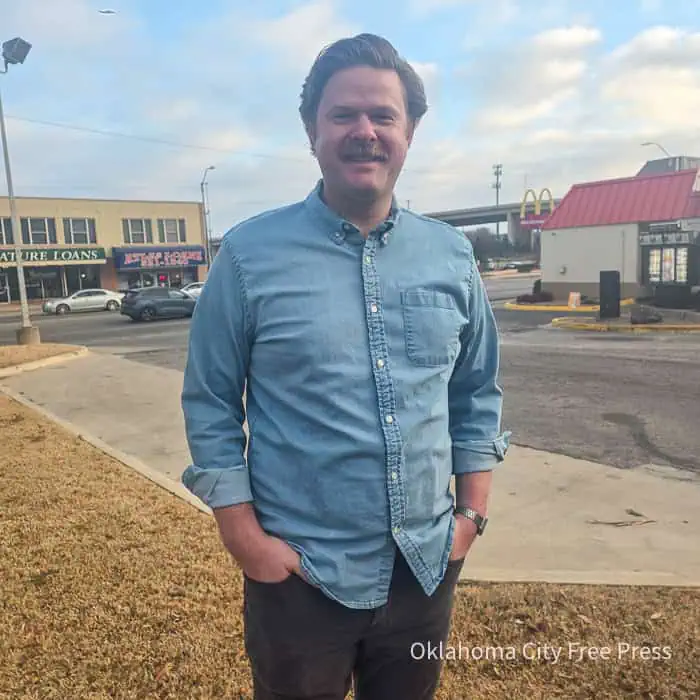
“Income inequality and unfair labor practices exist across the professional spectrum, and I think this is a pretty glaring example of a massive multinational company not taking the needs of their workers seriously, and I think it’s an example to anybody else in Oklahoma City or elsewhere who is working somewhere and is dedicated and passionate about the work that they do, but at the same time, feels neglected by management,” Bennett said.
He thinks it speaks to a larger conversation about democracy in capitalism. “People are increasingly frustrated…the best thing the management class could do is embrace unions because it is an organized, democratic way to push back against inequality.”
He went on, “In many cases, management is not the enemy. They embrace the unions because it’s an effective, organized way to discuss differences between management and their workers. And there are those, I understand, who don’t believe workers should have the right to negotiate this way with their employers, but I feel differently.”
“And I think a lot of people feel differently, and through the course of American history, people have felt differently, and very rarely have good things come to the masses without the labor movement, so we’re here to say the labor movement is alive in Oklahoma,” he concluded.

Alex Gatley covers labor activities in the state of Oklahoma.