OKLAHOMA CITY – There are few figures, images, or areas of iconography more immediately “American” than the good ol’ country cowboy, the Stetson-and-denim-covered picture of Americana wrangling a steer, racing a horse, or just working the land.
And yet, for too long there’s been something notably missing from that iconography, an element that’s been as much a part of it all from the beginning as the clothes, the cows, and the country itself:
The Black community and the African-American legacy of the Black cowboy.
With Black-led country music finally receiving respect and mainstream play through artists like Saboozey and The War & Treaty, organizations like The Black Opry, and most notbly, Beyonce’s mammoth “Cowboy Carter,” and with fashion and modeling campaigns co-opting the Black cowboy aesthetic, America is finally beginning to catch on.
But young Oklahoman photographer Jakian Parks has already been documenting the world of Black equestrianism and African-American rodeo culture through his lens for years, and Oklahoma Contemporary’s “The Black Land” – Parks’ first-ever solo exhibition of photography works – gives viewers a glimpse into the community’s sprit and multi-generational power in Oklahoma.

“I discovered that I really wanted to document the Black experience in Oklahoma, and that led me to rodeo,” Parks told a media gathering ahead of the exhibition’s public opening on November 6th alongside close collaborator and head curator of “The Black Land,” Chloe Flowers. “It was like a whole lifestyle that had been hidden.”
Parks’ own family has actually had ties to the world of Black rodeo through his aunt, and after her passing 2019, he found himself drawn toward the culture and community of the sport and the lifestyle around it once again.
“The Black Land” represents a document of his time spent meeting, connecting, and growing with the figures and families of Black equestrian culture in Oklahoma, removed from the mass media fashion and pop cultural aesthetics of the past year.
“It was important to highlight and to create a platform for Black equestrianism, which is very strong in Oklahoma City,” Flowers told the media event, “And so we just had to really start interviewing people, going to their houses, sitting in their living rooms. And he really wanted to speak to people who were in their 70s and in their 80s so that he could get firsthand stories about the past and how our Black cowboy history began.”

That reverence for the deep, rich history of the Black community in rodeo and cowboy culture – a history that stretches back to the earliest origins of American equestrian sports – gets much more than just a nod in Parks’ photography.
His framing, his approach, and even his decision to photograph these rugged, deeply human moments through the grit and tradition of real film all feel evocative of the classic western photography of the late-1800s or the Dust Bowl, placing his photos naturally into that history where Black representation was so long ignored.
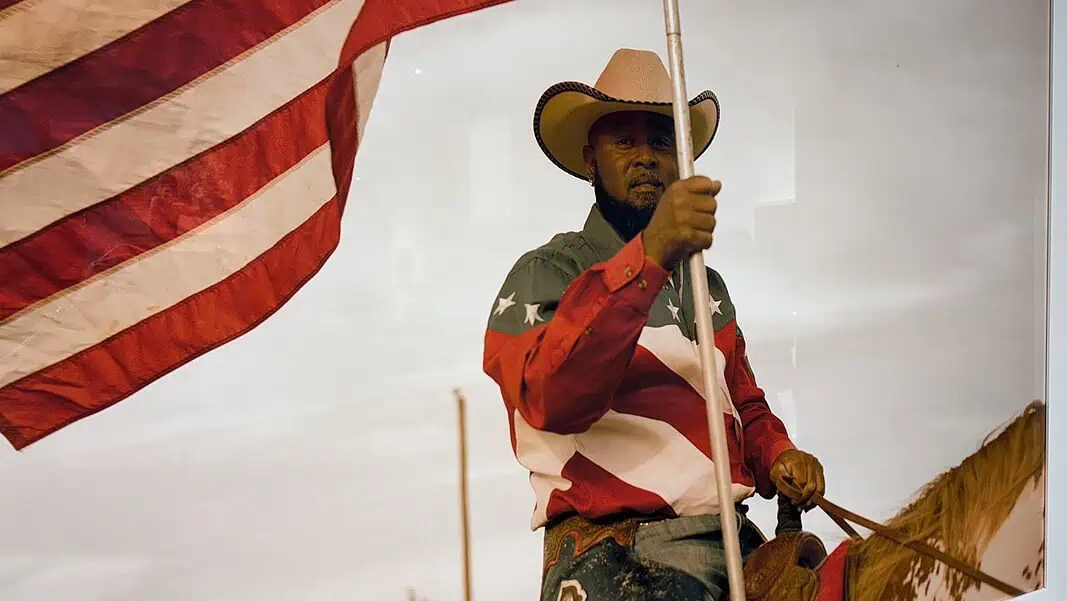
That feeling of reclamation and of proudly declaring the Black community’s place in this history comes through in nearly every photograph in the exhibition, but perhaps never more so than in “Star Spangled Ebony,” featuring Bob Johnson of OKC’s Eastside Round-Up Club holding Old Glory aloft, adorned in American flag attire.
The same dignity and strength is projected in the black-and-white “Grandma’s House,” a shirtless cowboy in white hat and chaps sitting expressionless in a characteristically “western” house in a scene that could just as easily be two hundred years-old.

But while that air of reverence and history is ever-present, “The Black Land” offers just as much easy comfort and everyday life.
A pair of lush, outdoor shots showcases a couple of slice-of-life moments on the modern range, projecting calm and the rooted bonds of friendship, and the striking “Adoration” features a young boy demonstrating total comfort and connection in an embrace with a fully grown horse, the animal’s overwhelming power causing no concern.
But perhaps no other piece in the show captures the true cultural depth of history and natural ease of the Black rodeo community more than the massive, wall-printed “8 Seconds,” a deceptively simple shot of a boy practicing bull-riding in pajama pants and socks, no worried fear or worldly exclusion to be found.

It’s the kind of photo, like so many in “The Black Land,” that places these everyday Oklahomans and the rural realities and rodeo-riding rituals of their daily lives – captured here in precise and time-honored technique – so firmly and appropriately among the too-long exclusionary pages of history.
“It’s definitely ‘Old West,’” Parks told OKC Free Press following the media presentation. “I love history, and I try to twirl this logic of history and to make these look like historical photos with that old vintage look. Even though a lot of these were taken in 2025, I’m also trying to tell history through all of this.”
Jakian Parks’ “The Black Land: Rituals and Rejoicing” is on display at the Oklahoma Contemporary Arts Center now through June 1st, 2026.
For more information, visit oklahomacontemporary.org.
Brett Fieldcamp is the owner and Editor in Chief of Oklahoma City Free Press. He has been covering arts, entertainment, news, housing, and culture in Oklahoma for nearly two decades and served as Arts & Entertainment Editor before purchasing the company from founder Brett Dickerson in 2026.
He is also a musician and songwriter and holds a certification as Specialist of Spirits from The Society of Wine Educators.